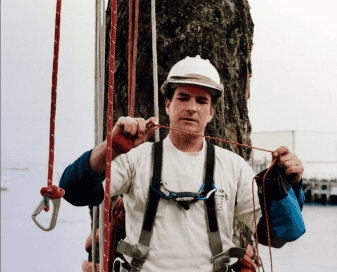
Climbing and Rigging During Crane Use
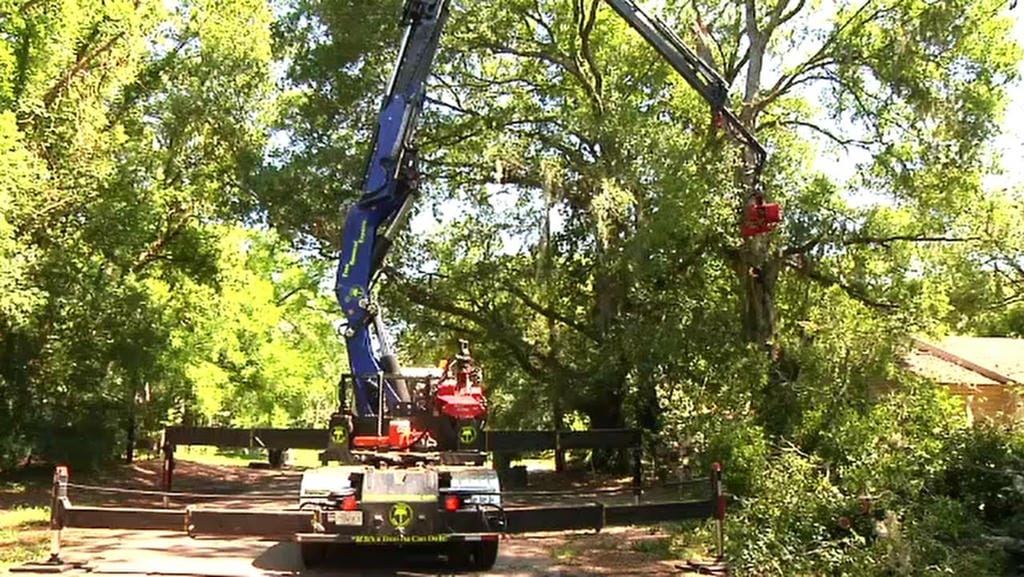
Climbing and Rigging During Crane Use
By Todd Kramer, CTSP
At Kramer Tree Specialists, we have been using cranes almost daily for 25 years. When we started, we had no training, as it wasn’t available in the early ’90s. We simply learned from experience. Learning from experience is a necessary evil in our industry. Often, you must learn from your mistakes and successes. One limitation with learning from experience is that there is no lesson plan. If you are new to utilizing a crane or have never had any training, I would recommend seeking it out. There are many avenues available for training these days.
With an increase in crane use, there is, obviously, an increase in exposure and therefore an increase in accidents and injuries. With all the investigations I have researched involving crane accidents in our industry, at least three factors are consistently present. One is a lack of planning on the front end of the job. Another is a lack of communication on the job site. Finally, poor rigging is often part of the equation. For this article, I’ll focus on the responsibly of the climber/rigger while performing crane work.
Climbing
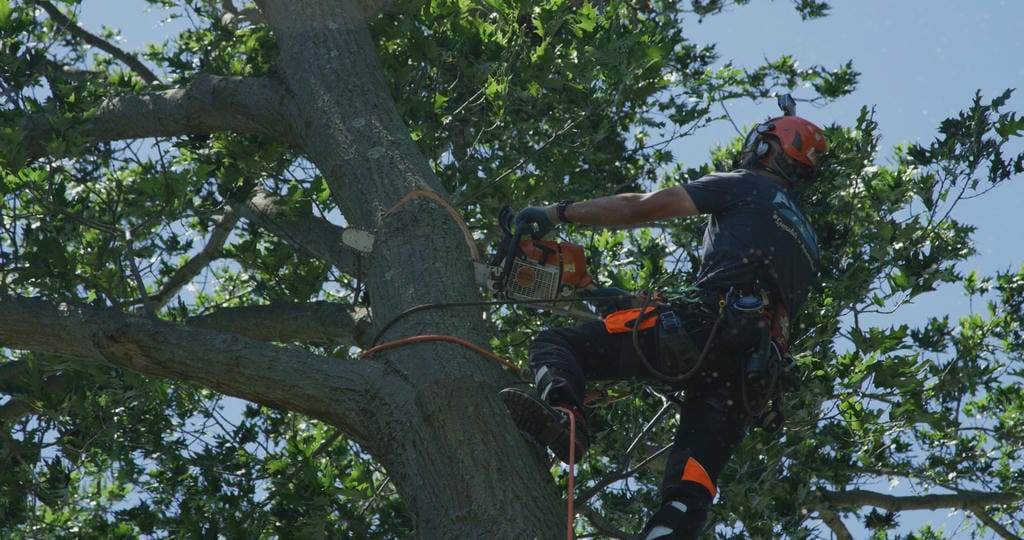
Over the years, I’ve heard so many times that climbing with a crane is easy. Well, I’m here to tell you that it is not. You’re often dealing with larger saws, larger rigging equipment and so on. Plus, you’re often getting more trees or larger trees done in less time, so you’re basically doing more.
So let’s start at the beginning. The crew arrives at the job site and the planning on the front end is spot on. You have all the correct equipment and the crew is competent and trained to do the work. So where do we begin? One of the skills I see lacking in our industry is a solid job briefing. A well-performed job briefing is crucial in our line of work. This becomes more apparent when performing crane work because the consequence of a failure is great.
The crew should start by identifying all hazards and obstacles and have a plan to mitigate them. The crew then should identify the equipment placement/landing zone. During the discussion, the crew should identify a work plan and a communication plan for all.
Communication during crane work is essential. The climber and the crane operator need to interact with each other. Some groups use hand signals and that works; others use some form of radio communication. We integrated radio headset communication some years ago and have never looked back. It has greatly improved our performance.
We recommend the climber and operator communicate for every cut made. The climber needs to know the capacity of the crane after deductions. Keep in mind that, while removing trees with a crane, you are basically doing demolition work. Demo work is quite challenging for any crane work because you don’t know the exact weight of the load, there are no engineered rigging points and you are totally committed to the load. Once it’s cut, it must be right, and this takes communication.
Because of the risks with demo work, we recommend not exceeding two-thirds of the crane’s capacity at any time. While climbing, I like to communicate systematically with the operator. This means we do the same thing for every cut. First, I need to know the capacity of the crane. Then I tell the operator how much I think the piece weighs and how much to pre-tension
the load. After it’s cut, I want to know what it actually weighs so I can enter that into my database for future cuts. Systematically communicating during the entire job greatly reduces the risk of a failure.
Rigging
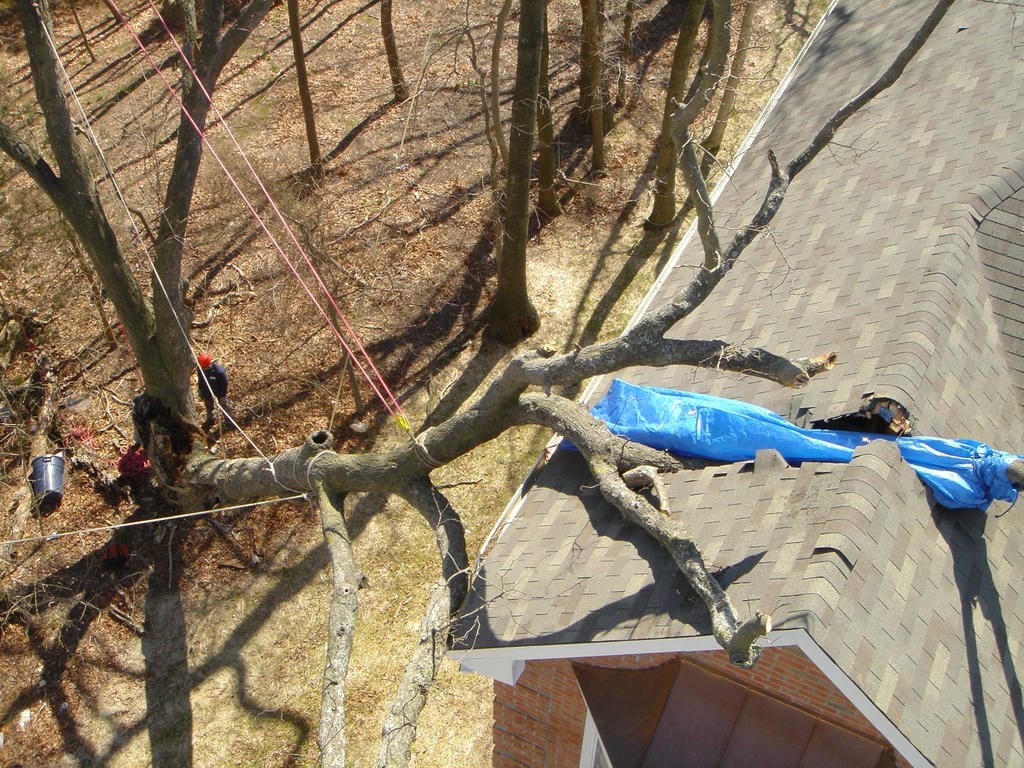
Now let’s talk about rigging. In my career, I’ve used all different types of rigging gear and techniques. As a climber and an operator, I prefer to use center-of-mass rigging. My goal is for the load to simply stay put after it’s cut. For the canopy, I prefer to use dead-eye rope slings, also known as spider legs. These are pieces of rope with a large spliced eye to hang on the hook. The rope is then adjustable to whatever length is needed. This makes it very easy to stabilize and balance loads. With slings of a fixed length, like nylon eye-and-eye or round slings, those lengths are fixed and it becomes difficult to equalize and balance the loads.
As a climber, I was always displeased when the load had lots of movement, as I feared a struck-by injury. As an operator, lots of movement or chasing a load is never fun; you could be worried about the load striking the climber or an obstacle. Plus, if the load is moving, it will cause dynamic loading that could put extra force on the crane, possibly overloading it. The goal with rigging is limited movement.
Now that the piece is rigged well, we need to make the cut. There are many types of cutting techniques that can be used. I only use a few. For vertical or nearly vertical wood, with the load equally rigged using two slings in opposing directions, I usually just make a straight cut. For most of the canopy, I use small step cuts. First, start with an undercut, then a top cut an inch or two closer to the stem. This creates a small shelf for the load to sit on.
For cuts that are near obstacles, I like to use a “V” cut. Mark Chisholm showed this to me. It creates a very large shelf, limiting movement in two directions. These two cuts need to bypass. This can be useful for the operator, as it gives him/her a chance to reposition the crane and get the boom perfectly centered over the load if necessary.
Work positioning
Finally, I’d like to talk about work positioning. This skill is often overlooked by the climber. Let’s start by referring to our ANSI standards. While performing any climbing, one needs to have two means of anchoring to the tree. This is for two reasons: first, if a climber needs to change to another anchor, they have the means to stay secured, and second, if operating a chain saw aloft, they need two points of connection.
Finally, while working on a spar with no limbs to anchor to, a climber needs to have a cinching anchor for their climbing system. This can be accomplished in several ways. One is to use an adjustable friction saver that is cinched up tight, so it cannot flip off the top of the spar. Another means is to use an SRS, or stationary rope system, and there are many ways to do this.
It is very important to have some type of anchor so the climber can easily self-rescue or another climber can easily rescue an injured climber. If you ever had any training on spar rescues, you know they are very difficult. During the planning process, I prefer to anchor to and climb the tree if possible. If that is the case, one thing to keep in mind is the placement of the load and your climbing system. The climber and operator should have a plan that keeps the load out of the path of the overhead climbing system. If the load were to strike the climbing rope, it could potentially injure the climber.
Also while planning, I try to leave material where I can have an overhead anchor or an opposing anchor. The idea here is to keep the bridge of my harness loaded instead of just using the work-positioning D-rings. When your bridge is loaded, it is physically easier to do the work, and I’m all for that.
Let’s keep in mind why injuries and incidents are happening: planning, communicating and rigging. If we concentrate on focusing on these issues, we should have better success.
You can find samples of rigging, cutting and work positioning on our YouTube page, “kramertrees.”
Todd Kramer, CTSP, is director of field operations/education for Kramer Tree Specialists, Inc., an accredited, 30-year TCIA member company based in West Chicago, Illinois.
This article is based on his presentation during a “Crane Crew Training” forum at TCI EXPO in Columbus, Ohio, last November. Another portion of that forum was the basis for the article by Travis Vickerson, CTSP, in this issue. The third portion of that forum is the basis of an article by Tim Walsh, CTSP, that will appear in the November issue of TCI Magazine. To listen to an audio recording of that presentation, go to this page in the digital version of this issue of TCI Magazine online, at www.tcia.org, under the Publications tab, and click here.



My SRT/SRS
(R)Evolution!
BY CHRIS GIRARD
How Map-Based Software Helps Win Higher Margin Work
Author:
Alec Sabatini
One of the best opportunities to differentiate your tree care company to potential clients is with a strong proposal. This small window of time with a client is where your company’s value and expertise can rise above the competition. This is where the advantage of map-based software really shines.
Map-based software offers a way for your company to back up recommendations with visual data that makes it easy for clients to picture the proposed work and see the reasoning behind it. Instead of racing to offer the lowest price point, visually demonstrate the value of your company’s expertise and why you are the one best suited to meet your client’s tree care needs.
Customers Are Changing the Buying Process
Technology has permanently changed the way customers make decisions. They are accustomed to visualizing their purchases in an online environment.They are more sophisticated in sourcing and evaluating proposals and they like to be able to review proposals when and where they want.
Using a map-based software process not only shortens the time between field assessment and proposal submission, it offers your recommendations in a way that meets customers’ modern expectations for digital accessibility. For example, map-based proposals can facilitate ‘virtual walkthroughs’ of the property when in person meetings are not convenient.
For many clients, the visible metric of proper tree management is a simple one. Do their trees look healthy? Clients may not understand the full arboricultural value of your company’s recommendations but they can easily gauge the quality of service being provided. Prompt arrival, clear safety protocols, and clean uniforms all help your company’s appearance match the superior work being done. An engaging and accessible map-based proposal is another way to establish credibility with potential clients.
The Basics of Map-Based Software
It all starts with a geographic information system (GIS), which is a framework for connecting data points to a location on a map. These data points, often called features, can include attributes like species, size, condition, photos, work history and more. Geo-referenced data points are usually organized into layers and they help give locations a ‘real world’ context. Spatially cataloging tree attributes into layers can reveal deeper insights into the data, such as patterns and relationships that clients may have never considered and competitors might have missed.
Map-based software can also be cloud-based, meaning it operates and stores data through the internet. This allows all users to have real-time access to the data as soon as it is logged. For example, an estimator can complete a field assessment and then an office administrator can immediately transfer that data into a proposal format. It also facilitates the sharing of interactive maps through a simple web link sent to the customer.
Starting The Proposal Process
The start of the proposal process is always about understanding your customer’s needs. Asking open ended questions about ‘pains and desire for gains’ helps you better understand the customer’s problems and what solutions you can offer.
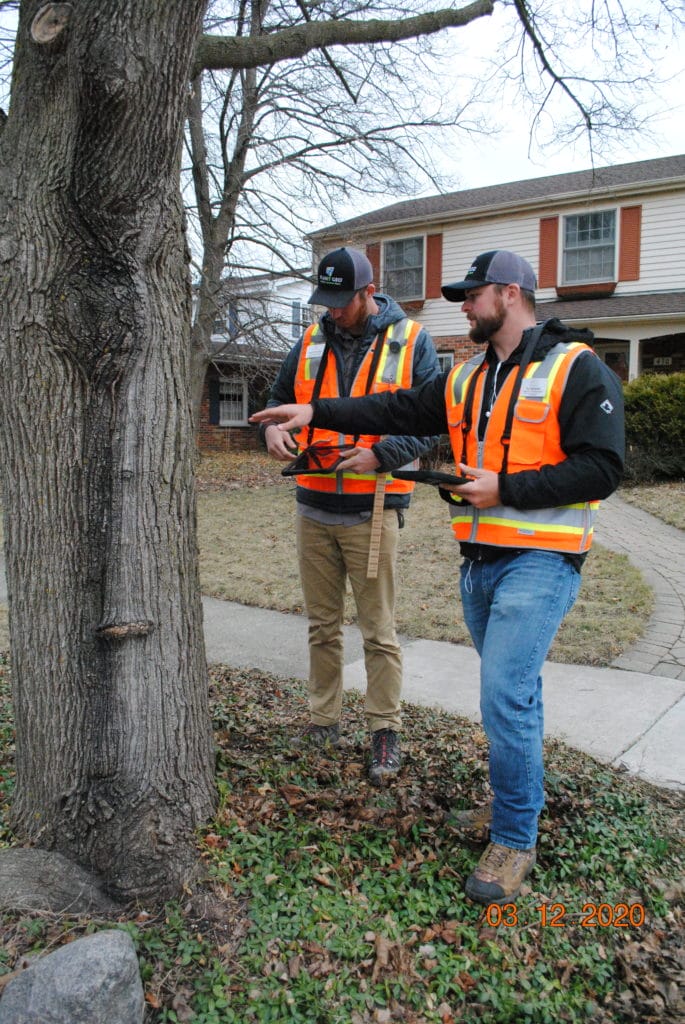
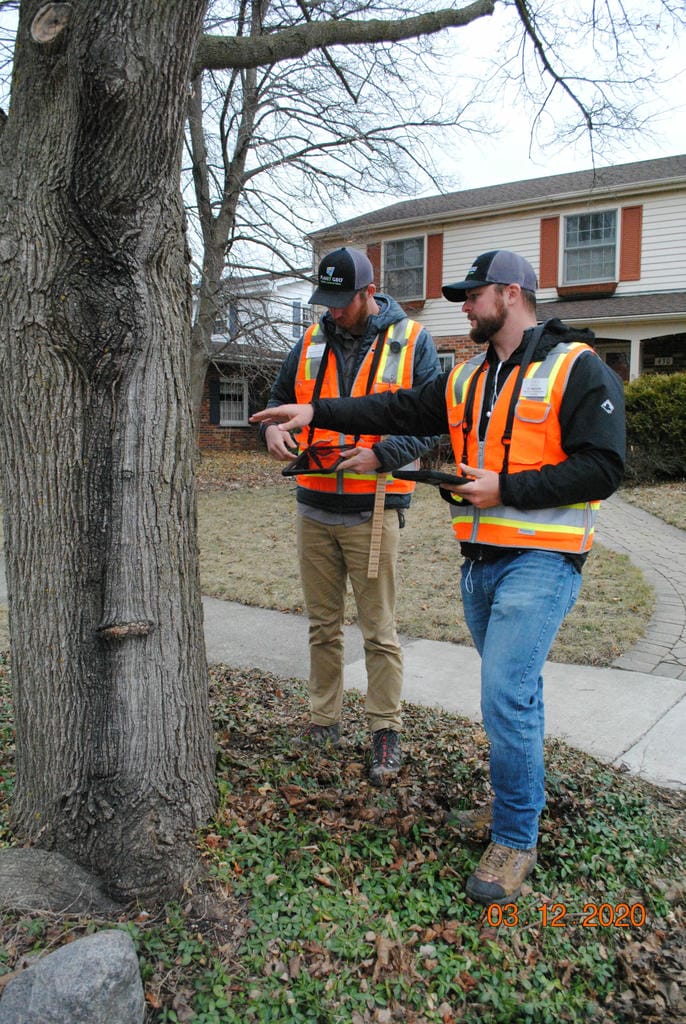
The next step is the site assessment, where each tree is inspected and the maintenance needs are defined using both the customer’s goals and your own arboricultural knowledge of health, structure and risk. Collecting this information and referencing it to mapped locations of trees sets the stage for the story you will tell in your proposal.
Collecting additional attributes, such as signs of disease, structural defects and photos, will explain the reasoning behind your maintenance recommendations. It is also a valuable record keeping practice so that future estimators can use that data to stay informed on previously identified problems and track their persistence. For example, a new driveway is installed in the vicinity of a tree and this new development is noted in the software. When soil compaction starts to kill the tree
five years later there is a historical record to trace back the true origin of the problem.
A Collaborative Approach
Data visualized in a map setting tells a more powerful story. Trees can be color-coded by any attribute, the basemap can be selected from a variety of imagery, and the maps you create can be shared with clients via URL. This allows the client to engage with your proposal, zoom in, and click for more detailed information. .
This often facilitates a conversation about what you as an expert arborist have assessed as priorities (tree health, hazards, etc), and what the customer views as a priority. We often hear statements from the customer like “I see that you are recommending pruning the high risk trees in the back parking lot. I want to also focus on this particular area in the front, as it is the first impression for residents entering the property, and it should look the best.”
This type of feedback is an opportunity to now adjust your proposal to highlight the customer’s shared priorities. Proposal maps can quickly be updated to reflect these changes by setting priority zones or altering tree color coding. Property managers often have more work than they can handle. When you can offer a comprehensive but clear proposal that showcases just how their needs will be met, it makes their job easier, and they look like a rock star to their clients. This builds valuable rapport and trust toward securing present and future work.
Operationally, reviewing the proposed work visually can help the customer identify potential work zone conflicts. You can save valuable production time when you better understand high traffic areas, parked car conflicts, or times when areas may be inaccessible.
Streamlining The Process
Map-based software lends itself to an easily repeatable process for field arborists and estimators to follow. You can scale this process by quickly training new estimators on how to efficiently assess trees, collect data on pre-made templates, and then transfer that information to pricing sheets and proposals.
This facilitates faster field assessments and therefore, faster delivery of proposals to the customer. Customers appreciate quick turnarounds, and you can rapidly grow your sales pipeline and gain more opportunities to win work.
A streamlined process helps your brand become synonymous with consistent and timely communication. Clear expert recommendations and high quality proposals can command higher prices and lead to higher gross margins. Customers see more value in a service provider when they better understand why recommendations are being made, and trust that you have their best interest in mind.
Why Me? It’s All About Differentiation
Map-based software makes it easy to demonstrate just how much better you can manage the customer’s properties vs your competition. Each maintenance recommendation and management strategy you propose can be backed with data and analytics the customer can see for themselves on your mapped proposal.
For example, you create a map that visualizes the trees color coded by condition and a pattern emerges that would have been hard to spot when just looking at a spreadsheet. A particular area of the property has a higher concentration of fair and poor condition trees (yellow and orange dots). This may indicate there is poor soil or ineffective irrigation in this area. Diagnosing and solving this problem will be going above and beyond your competition, who just recommended pruning and removals of the poor condition trees.
Effective Communication and Record Keeping
Tree jobs are typically project based, meaning you visit the property during a specified period during the year with a specified scope of work. Great project management hinges on great communication.
You can show your prospective customer how to create a login to view tree maps, and then send them daily or weekly interactive maps highlighting which trees you will be working on next. This makes it easier for the customer to help prepare the work areas, or catch upcoming conflicts and notify you of the need to alter schedules. Maps can also be made publicly accessible, allowing municipal clients a new avenue for their constituents to engage with their community forest and better understand the work being done to maintain it.
You can also show your customer how good record keeping is critical in protecting against liability and negligence claims. By adding a work history record each time you treat or prune a tree, you are storing evidence that all trees are being properly maintained. This information will become essential in the event of litigation due to a tree failure as the customer can explicitly demonstrate there has been no negligence of tree maintenance.
Final Thoughts
The key to winning more business is to stand out from your competition. Your proposal is the best opportunity you have for differentiation. A proposal that tells a visually compelling story, that is structured around the customer’s expressed needs, that identifies patterns missed by competitors, and is easily accessed stands out. Start making high quality proposals with map-based software and start winning more work.
Author Blurb:
Alec is the content writer at PlanIT Geo™, a global urban forestry consulting and software development firm, and develops educational content at the intersection of trees and technology. PlanIT Geo’s TreePlotter™ software suite is used worldwide by private tree care companies, governments, and nonprofits for tree inventories and asset management. More information on strengthening job proposals with software is available here.