Home Blog Page 9

Simple Lowerable Base Anchors
0

   Simple Lowerable Base Anchors

By Macintosh Swan CTSP

This article is going to explore two different stationary rope work positioning (SRWP) anchoring systems and my experience with them. These are not systems I created, just modified to fit my needs.

I am not going to get into the forces inherent in any climbing systems, but climbers should always be aware of how their chosen systems interface with the tree they plan to hang their life from. I am going to discuss why I choose to employ a climbing system anchored at ground level that can, in case of emergency, be operated by someone familiar with such systems to aid in lowering me to the ground.

When I began using SRWP, I employed canopy anchors more often than not. At first base anchors only seemed useful in situations where it was not easy to isolate a limb. But as I become more comfortable with SRWP it became apparent that the possibilities for base anchors far exceeded that narrow spectrum. Now, I employ base anchors almost every time I prune a tree, and will quite often begin full removals on a base anchored system. As with all things there are positives and negatives to a base anchored climbing line. A few of the things to keep in mind are:

  1. There are two legs of line supporting the climbers’ weight; be careful not to cut either.
  2. The climbers’ weight can be multiplied greatly at the primary support system (PSP), especially in the case of a fall.
  3. Be sure to keep the climb line clear of any rigging operations.


Okay, so that list is a little tongue in cheek, since most, if not all, of those could be applied to doubled rope (Ddrt) or canopy anchored SRWP systems as well. But here is my point; there are no more or fewer factors to keep in mind with a base anchor than with any other climbing system. There are simply different ways to manage the inherent risks of climbing up a rope into a large plant to work with sharp edged tools. In my eyes the only thing that is augmented by the base anchored system is the possibility for rescue from the ground.

I had been experimenting with base anchors that would allow my ground crew to lower me in an emergency. I was always somewhat behind on making sure everyone on the crew knew how to operate my systems though. And the company would experience turnover, so there were people who knew nothing about what I was using. Depending on the day it didn’t matter what I set up because the person with me on the ground would have no idea what I was climbing on.

Then, last summer I met someone at a TCC (tree climbing comp). Later in the year I heard that this individual had been hurt pretty badly in a fall during an attempted base anchor rescue. This woke me up. What was the point of setting up this measure of safety if I didn’t explain its use to my crew and impress upon them its usefulness?


The first step was to utilize the simplest systems I could make. This led me to streamlining the system I had been using already. As well as finding an even simpler method for situations where, in the past, setting up a lowerable anchor would have seemed too time consuming.
mac6

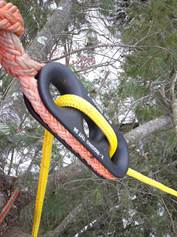
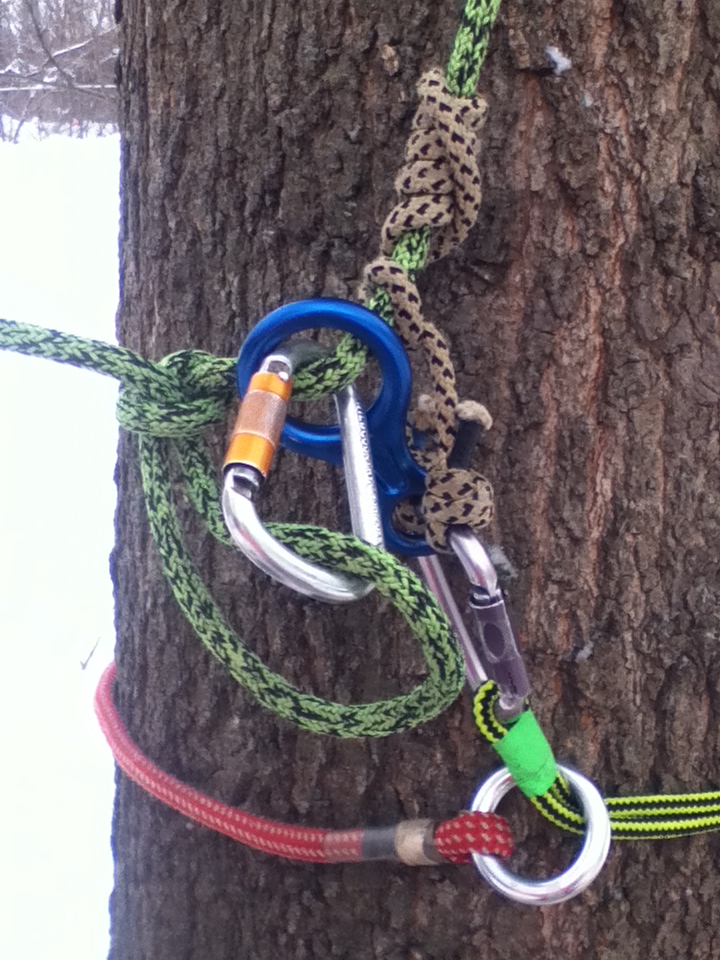
This is the first lowerable anchor I gleaned from Treebuzz and personalized. The anchor (the red and white rope, with yellow and black adjustable prussic) cinches around the anchor point. A friction hitch attaches the line to the anchor; friction is then added below it in the form of a “stitch plate” created by passing a bight of the line through a figure 8 and capturing it with a karabiner. I then finish it by tying a slip knot in my line and attaching it to the same karabiner that forms the stitch plate. The slip knot cannot be pulled tighter from above, and it serves as a fail/safe for any slipping in the friction hitch system.

In a rescue situation, all the rescuer has to do is open the stitch plate karabiner, take the slip knot out of it, let the karabiner close, pull the tail of the slip to untie it, then lower the climber by manipulating the friction hitch. What I appreciate about this system is that there are few actions for the rescuer to remember (open a karabiner and untie a slip knot), and the friction hitch is a simple operational concept, one that most tree crew members are probably familiar with.


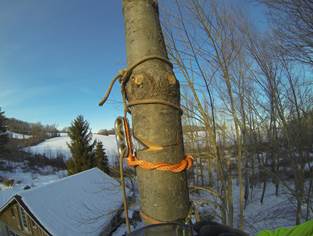
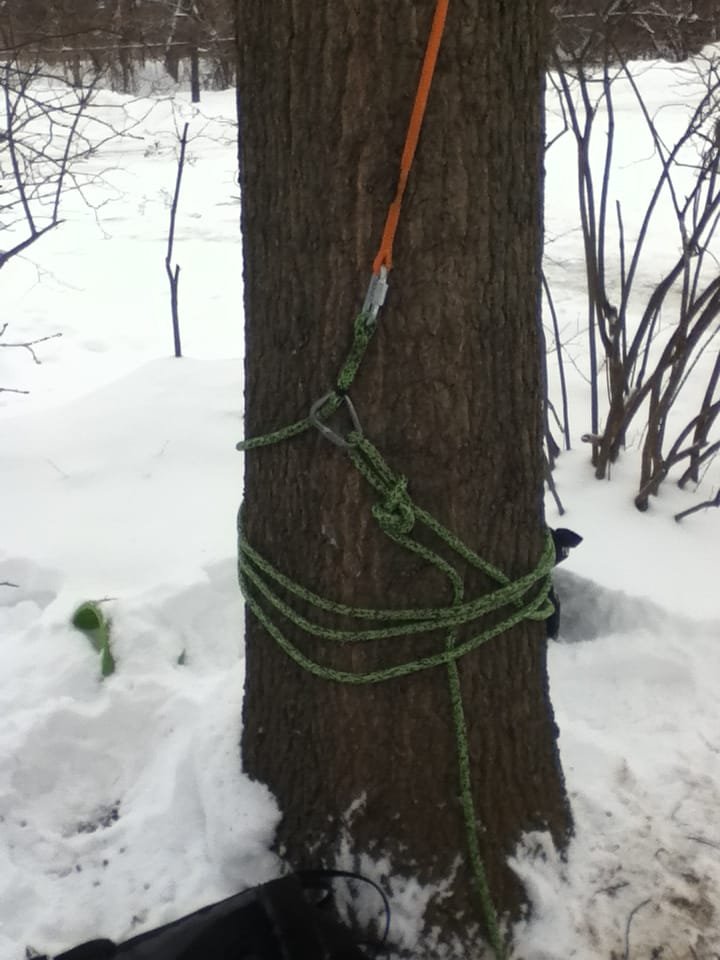
The anchor I now use most frequently is another that has been adopted and adapted to fit my needs and the gear that I had on hand. It is formed by taking multiple wraps around the anchor point with the climb line, then passing a bight up between the wraps and the trunk, tying a midline knot, and attaching it to the anchor leg of the line with a steel quick link. The wraps tighten on the bight which tends to hang loose from the quick link, enabling a rescuer to get the quick link opened and disengaged with relative ease. The knot is then untied, the bight is pulled out from under the wraps and the climber can be lowered. This system, while technically not fail safe can be made virtually so through the addition of wraps on the trunk.mac1
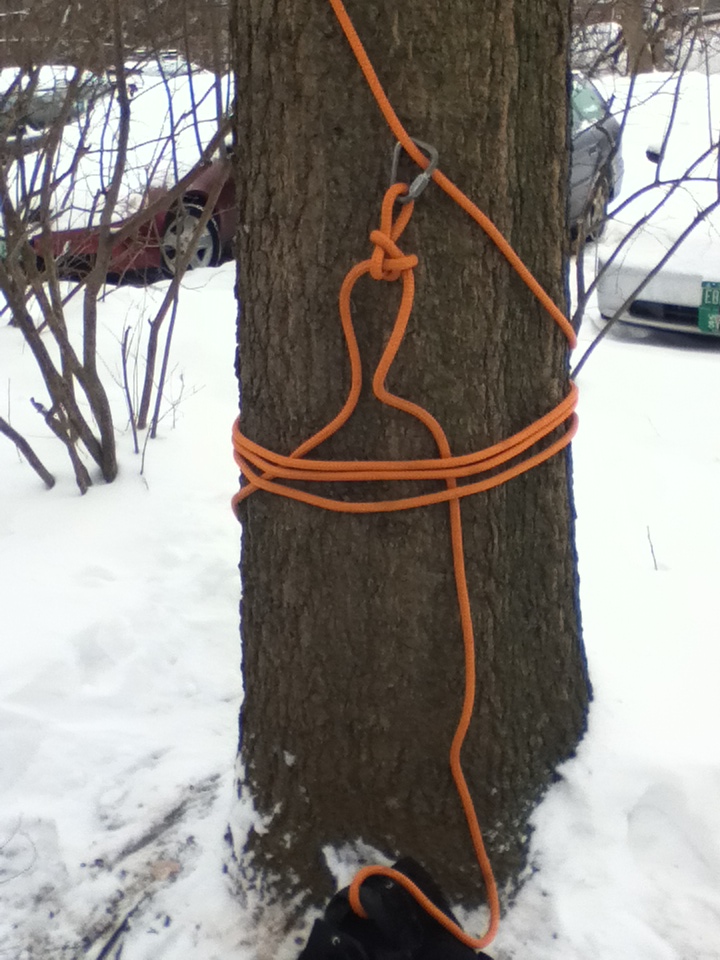


I have climbed on both of these systems extensively, have fallen into them, and been lowered on them from the ground in rescue practice. I have run my line through multiple redirects imposing a large amount of friction on the rope and still been able to reach the ground. However, it may not always be possible for the climber to be lowered if the rope is through multiple redirects, depending on the style of the redirects (static, semi-static), as well as the individual tree and its branch structure and bark texture.  It would also not be possible to lower a climber who is secured by a positioning lanyard to a part of the tree structure, but is unable to release the lanyard for some reason. Even the tree structure itself could impede the lowering of a climber who is unable to navigate it themselves. These would be factors to be considered closely before attempting to rescue a climber from the ground. In these cases it is possible that a lowerable base anchor could still make for an easier rescue, with an aerial rescuer simply facilitating the lowering of the victim.

Ensuring there is enough rope in an anchor system to allow for the lowering of a climber is one of the easiest things to overlook, and should be the first thing you are certain of before setting up a lowerable base anchor. There is no point taking the time if you are going to run out of rope before touchdown. The obvious answer is a very long piece of the finest kernmantle that money can buy. That is unfortunately not always an option. Even a 200’ rope can seem to disappear quickly once you start setting redirects. So my solution is to connect two ropes together via a steel quick link. The most useful shape of quick link being the oval “chain” link variety, as it has the slimmest profile and is most likely to slide through a branch union.


In the cinching anchor system the two ropes would be connected just above the friction hitch so the climber would have the maximum amount of rope to be lowered with. This also maximizes the distance between the quick link and the first branch union

.mac3
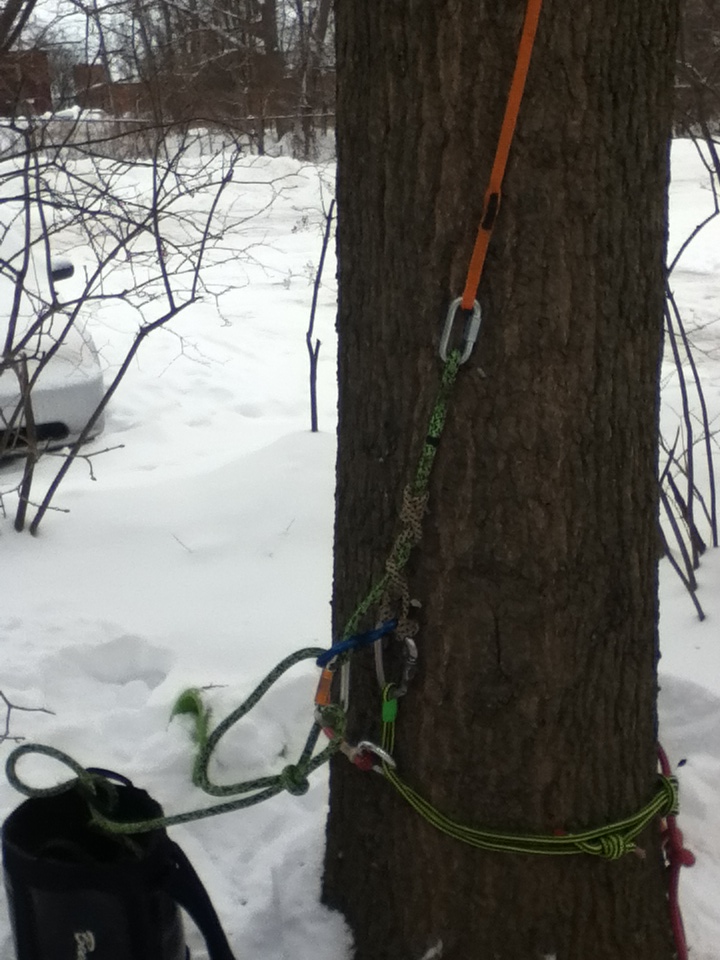
 

In the trunk wrap system the two ropes can be connected below the wraps on the tail of the bight. Or above the wraps, as in this picture, just past the delta link, again to maximize possible distances for lowering, and give the climber plenty of working end.
mac2


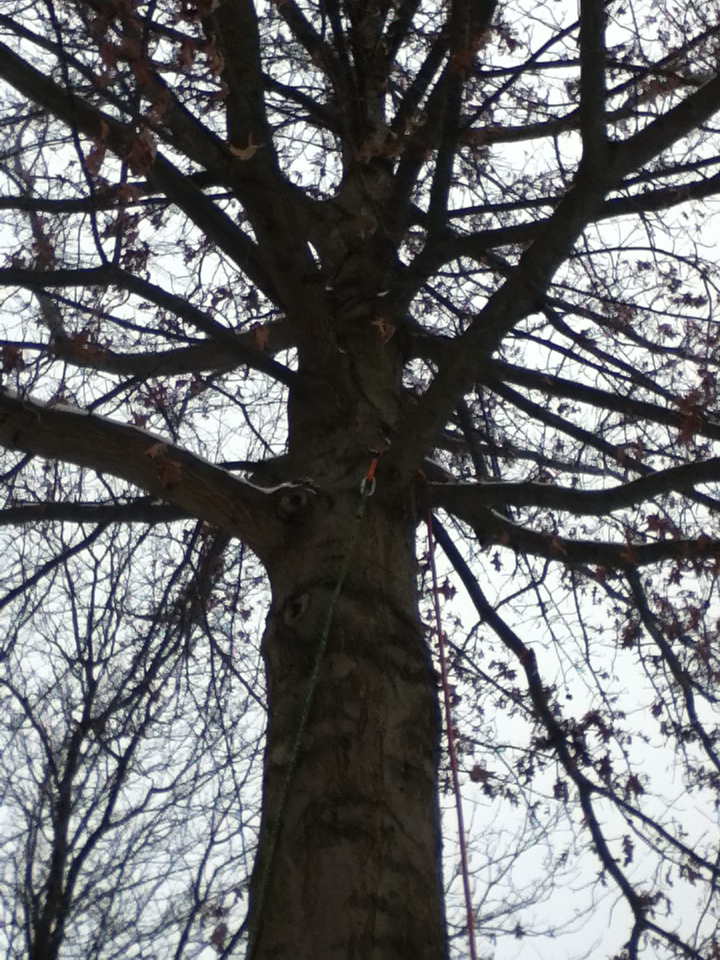
Another option for either of these situations is to have the quick link on the working side of the PSP so that the only obstacles would be any redirects the climber has set.


mac4


The two systems I have highlighted here are simply that. Two possible systems, which are infinitely adjustable to your climbing style and available gear, if you have a rated, appropriate belay device, you may want to skip the friction hitch and just set that on a cinching anchor. There are numerous ways to anchor your line with trunk wraps, this one just works really well for me.  The end goal is not which system you wind up using, just that you consider using some sort of lowerable system, so that you the climber have more options to ensure your safety.  Remember that everyone on the crew needs to train thoroughly and review often. In an emergency, someone on the ground will be in a position to save your life, or make your situation significantly worse.

Have fun, climb safe, go home.


RISK MANAGEMENT IN A BASE ANCHORED SYSTEM ·         Be sure of the PSP you have chosen, that your line is set firmly, is free of obstructions, and will not shift suddenly. Do not climb on a rope over something that will not support your weight.

 ·         If necessary set your base anchor on an adjacent tree to keep your anchor line away from your work.

·         Keep track of the anchor leg of your rope at all times during your work.

·         Be sure that your ground support is aware of your system, its placement, and the workings of its components.

·         Be sure that there is enough rope underneath the anchor point to allow for a rescue from the ground


 

2015 ITCC Rules Are Now Available

0

ITCCLogo_home_web

ITCC Rules


The ITCC rules are reviewed annually by the Rules Committee. If changes are required to make the event safer, follow changes in industry standards, or create a more efficient method of event scoring, those changes are made during the review period which is generally held October through December. The most current version of the rules can always be found at this location.

Current ITCC Rules

ITCC Rules (as of February 13, 2015)

The official ITCC rules are published in English. Some translated versions of the rules are available but they may not be the most current version of the ITCC rules. (Translations)

Rule Books

Copies of printed rule books are also available for purchase. To purchase rule books contact ITCC.

Rules Comments and Questions

The ITCC Rules Committee welcomes comments and suggestions for improving the competition rules. Questions regarding rules clarification are also encouraged.

If you would like to submit a comment, question, or suggestion regarding ITCC rules, please use the online submission form.

Reach Out Worldwide

0


Dear Prospective Reach Out WorldWide Team Member,
My name is Danny Nausha and I am a Fire Captain with the City of Pasadena and the Saw Team Leader for Reach Out WorldWide. We are currently looking for highly-skilled crew members to join us on future deployments as part of Reach Out Worldwide’s Saw Team.
Reach Out Worldwide (ROWW) is a 501(c)(3) registered nonprofit founded by Paul Walker. In January of 2010, after massive earthquakes devastated Haiti, Paul spontaneously organized a relief team that responded to the disaster. On the trip, Paul saw a gap between the availability of skilled resources and the requirement for such personnel in post-disaster situations. Upon returning from Haiti, ROWW was established with the purpose of filling this unmet need.
A primary resource that ROWW provides in response to natural disasters is volunteers with professional tree falling and bucking experience. We are currently looking for new recruits who want to volunteer their time and assist in disaster hit areas as a ROWW Saw Team member.
As a ROWW team member you will be called upon to deploy with ROWW after a disaster strikes. Travel expenses are paid for by ROWW during the course of the deployment. We expect our volunteers to be professional and ready to work hard to carry out our founder’s mission of helping others in their greatest time of need.
ROWW has an amazing network of partners and supporters, including STIHL USA, who provide chainsaws and additional equipment that we need to help us accomplish our mission effectively. This support, coupled with our highly-skilled team, allows ROWW to continually carry out successful deployments in fulfilling the unmet need.
If you are interested in joining the team please contact me at danny@roww.org with a brief description of yourself, work experience and your contact information. Additional information regarding ROWW and our mission can be found on our website at www.ROWW.org and on Facebook. I look forward to talking with you, and thank you for your interest in Reach Out WorldWide.
Sincerely,

Danny Nausha
danny@roww.org


ROWW-CodyWalkerCover        ROWW-3Main-Oklahoma
“When you put good will out there it’s amazing what can be accomplished.”
700 S. Flower St #201 ▪ Burbank, CA 91502 ▪ (818) 972-2946 ▪ info@roww.org ▪ www.ROWW.org

WHERE SHOULD FRICTION BE IN OUR ROPE RIGGING SYSTEMS?

0

WHERE SHOULD FRICTION BE IN OUR ROPE RIGGING SYSTEMS?


Hello fellow arborist.  I am not an engineer and I am not a technical writer.  I am going to write on the level of most of us; because I am a tree guy, like most of you.  I will write my articles from what I observe and what I have learned over the years by real work experience.  I will not be researching numbers, angles, technical information and regurgitating it here in an attempt to seem brilliant and above most of the readers.  In doing so, hopefully, reading what I write will get to the point, be interesting and understandable.


We need friction in lowering weight, so where should it be?

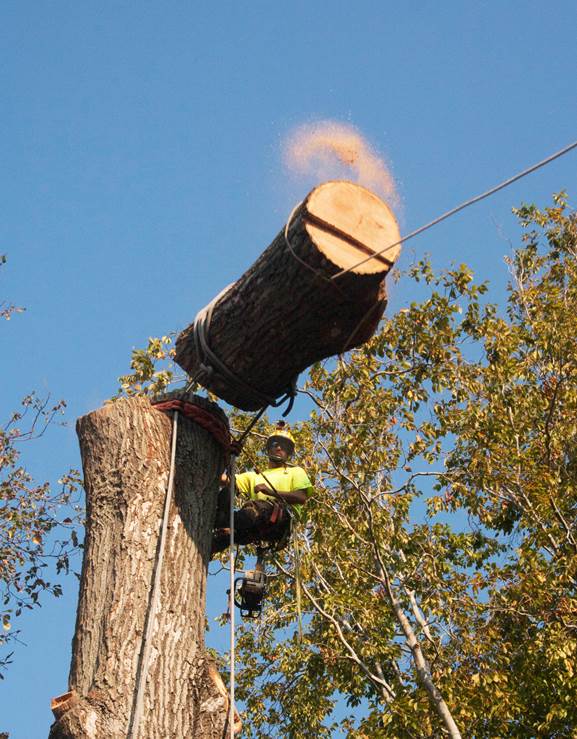
When climbers need to lower limbs or logs and the weight or force is more than a person can handle; friction is needed somewhere in the rigging line in order to control the decent.  In the last 50 years or so in arboriculture, the common practice has been that friction is applied to the rope at the base of the tree to allow a person to handle large weights.  This is usually done with either a lowering device or the old school way of doing wraps around the tree trunk.

pic2 


This brings to mind a funny story someone recently told me.  They said that at their tree service company, they use the Hobbs lowering devices. [which you may know is a serious, big and heavy tool]  They told a friend (that also had a tree service) that he highly recommended the Hobbs lowering device.  Consequently, that friend purchased a Hobbs LD.  After the first week of use; the veteran Hobbs user calls up his friend and asked how does he like his new Hobbs?  He answered that it is okay, but it takes them a VERY long time to haul it up to the top of the tree and is exhausting to do so. 

I laughed when I heard it, but you know what?  That guy had something right, whether he knew it or not.  He was thinking of adding friction at the top of the tree.


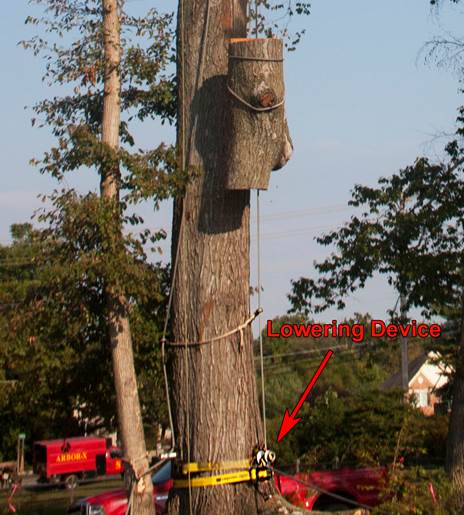
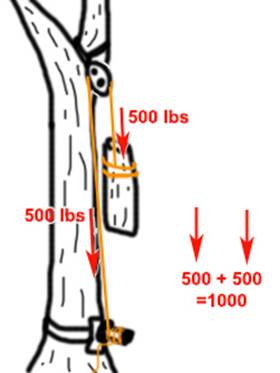
You see, if we have all of our friction at the bottom of the tree and we are using near-frictionless blocks and pulleys, we are multiplying the forces on the rigging points.  For a simple example; hanging a 500 pound log off of a pulley up in the tree and to a lowering device at the base of the tree; the system doubles the force applied to that block, the sling and the rigging point in the tree.  So at least 1000 pounds is applied to that rigging point when using a pulley/block and friction device at the base of the tree.

pic3 

  Then, apply the multiplication of a load falling some distance, such as negative rigging and the forces applied can be huge!  Then add in a mistake such as a “no-run” and sudden stop and things get even crazier.

To deal with these forces, crews needed to have ground people with excellent lowering skills that could let the tree material “run” towards the ground and slowly decelerate it. 

If the ground person does NOT let a heavy log or limb run and slowly decelerate, the climber can easily get bounced around and hurt.  Or the sling on the block could fail, or the rope could fail, or even worse things like the tree failing.

I fortunately have had excellent ground people over the many years and they have mastered the art of letting material run, then slowing it to a stop where needed.  However, I have also been through the jarring motions of too many wraps or the fear of an inexperienced person freezing up and holding tight to the rigging rope.

I know a lot of climbers that have completely given up on lowering large logs and limbs; it’s not worth the risk to them, they have had too many bad experiences.  Many climbers would rather play it safe by cutting pieces small.  This often is not efficient and in some cases light weights can be close to impossible with large diameter trees.  I have friends that take things small and claim that they are very efficient and fast at it and I do believe them.  In my area, most of the wood gets hauled away and not left on site as firewood rounds.  I would rather haul away logs and get paid for those logs rather than move around numerous firewood rounds.  I also would rather see a 40 foot long limb go through the chipper in one piece instead of that limb in 6 pieces.  But that’s just me and my area of work; let’s get back to the subject.

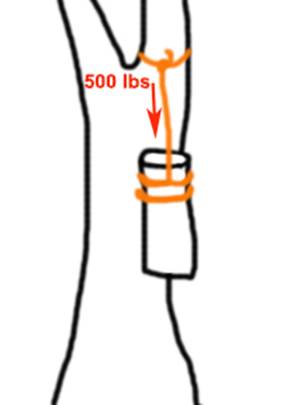
Now, instead of a block in the tree and a lowering device at the base, let’s go to the top for the example.  IF you take a single leg of rope and tie a 500 lb. log and hang it from a tree, you are applying 500 lbs. to the tie point. There is only one leg of rope pulling down on the point that you tied the log to.

pic4 


So, you might be thinking, well, let’s apply friction to the top of the tree.  This is okay and can be great when used correctly. People have used porta-wraps, figure eights and the tree itself when they understood this concept.  It definitely lessens the force put on the rigging point.   However, there is often very little rope length being used in the system between the friction device and the load.  Short rope length can be a VERY bad thing.  Long lengths of proper rigging ropes have stretch and can help absorb shocks and jarring.  A person could also use natural crotches and wraps in the top of the tree.  This is a unique skill and requires a lot of experience.  Varying diameters and bark types can make it hard to judge from one tree to the next.  If a person gets it wrong and the load does not run, they are shock loading a short section of rigging rope.  If this keeps re-occurring, they are fatiguing the end of that rope over and over again until one day it breaks.


Smoother Lowering with the Magic of Friction


So, how about something in between?  How about a lowering device at the base and rigging point hardware that is not blocks/pulleys, but instead adds some friction and allows the entire rope length to be used?

Now, a block with clutch plates would be cool and likely work well if there was such a thing; where you could dial in the amount of braking on the sheave of the block. But it would be expensive and blocks are already expensive. 

So, what would work with some friction, be simple, and not so expensive?

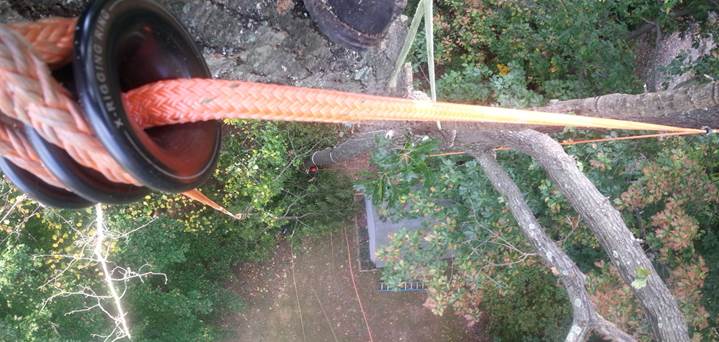
Well, the X-Rigging Rings (XRRs) were introduced to the arborist industry in 2012 by Xtreme Arborist Supply and they do just that.  These are a low friction ring that the rigging rope runs through.  When you are adding friction to a rigging point, you are not multiplying the force on the rigging point as much as you were when using a near-frictionless block.  When you have friction at a rigging point, you are lessening the force on one leg of the rope that is pulling on that rigging point.

pic5Photo courtesy of Xtreme Arborist Supply Inc.
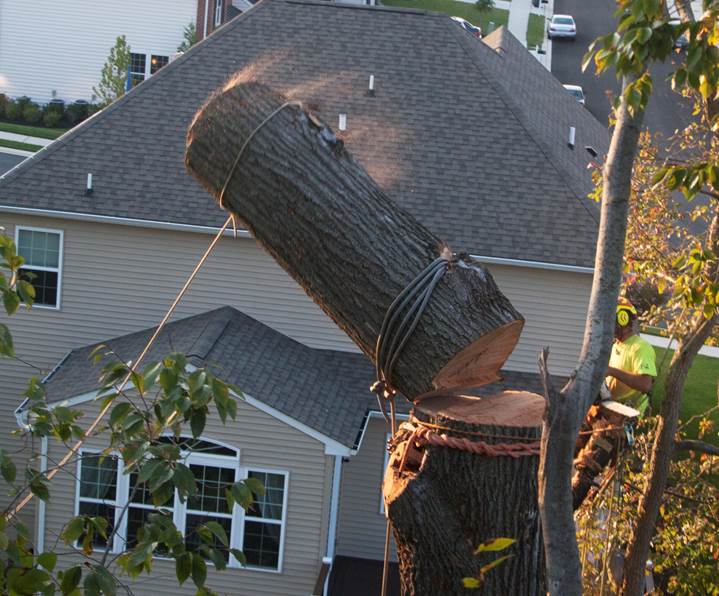
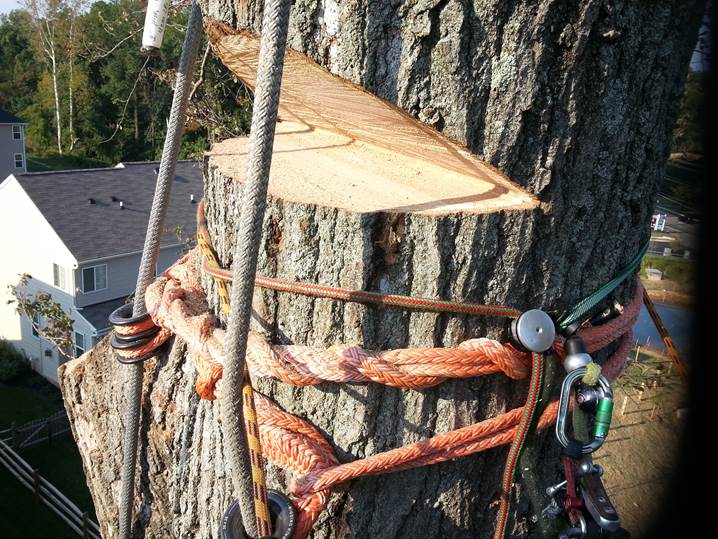
 

Since there is friction at the rigging points (on the rings) you are not multiplying the force as much as when using a block; if someone makes a mistake (as in not giving as much “run” as requested); the mistakes are not multiplied as much as it was with blocks.  I find everything is less violent.  Things go smoother.  The ground person does not have to be so perfect.  (Although, this smoothness and less violence has been tempting me to go larger and larger to find the edge of uncomfortable again.)  When we use several rings in a rigging system (such as a few redirects and then also rings as the terminal rigging point); on weights that we would normally have three required wraps on a Hobbs or GRCS, we now use only one wrap.  I have been using this type of ring since 2011.

Even the large red oak logs pictured in this article were lowered smoothly and decelerated to a stop about 6 feet from the ground. The redirects and rigging points were all X-Rigging Rings.

 pic6

Photo courtesy of Arbor-X Inc.


My ride was very calm and stress free.  On the largest logs, two 1 inch diameter rigging lines were used.  One rigging line ran from a Hobbs device, the other from the aluminum bollard on the GRCS(Good Rigging Control System), through a set of extra-large X-Rigging Rings (nicknamed the “beast rings”) -that pulled the lines away from the log slap zone on the trunk.  The terminal rigging points were two more sets of the extra-large “beast” rings in a double ring configuration.

pic7

On the numerous heavy logs, there was no smoking/glazing of rope at any of the rings or the Hobbs.  From lowering the heaviest log (3,760 lbs./1706 kg. ) there was a short ribbon of melted rope on the GRCS bollard; this was the hottest friction item in the system due to the bollard being somewhat thin aluminum compared to the aluminum of the Hobbs.  The hard-coat anodizing of the rings reduces friction heat on the rings; the “beast” 38×28 rings have a serious amount of aluminum to dissipate heat as well.


Sharing Loads

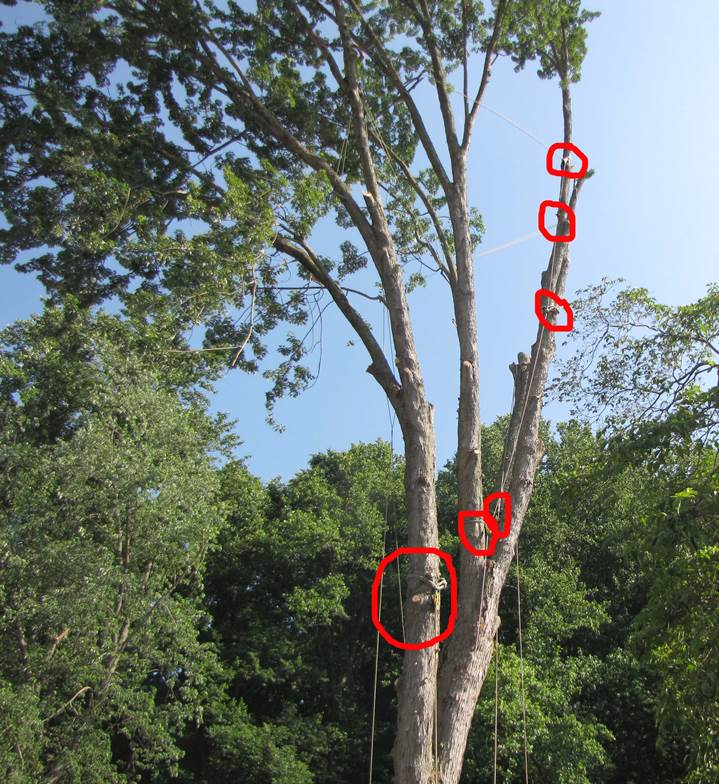
Smart rigging arborists like to use the trees structure to make the tree and system stronger.  Rigging redirects are very safe and effective, but most climbers do not understand how huge the benefit is.  If heavy weights are going to be lowered, or if the final/terminal rigging point is out on a somewhat questionable limb; rigging redirects should be used so that the rigging point in the tree is not broken.  Redirects use a tree’s shape to reduce forces on rigging points.  The final rigging point can even lift upward and improve as more weight is put on the end of the rigging rope if redirects are used.

You need a lot of rigging hardware if you are going to have multiple re-directs.  Multiple devices can add up to be expensive if each item is expensive.  In the past when I used blocks for lowering on large spreading tree removals; I could have up to 5 or 6 blocks in a tree.  Blocks that ranged from $220 to $600 each.  I could have $1700 of blocks in a tree and that doesn’t include the cost of slings.

pic8

Photo from the past, showing multiple arborist blocks in a spreading silver maple removal.


High costs prevent people from purchasing hardware for redirects. Redirects make things safer, but if redirects are costly in hardware, a person might tend to now own that hardware.

An inexpensive low-friction devise is the way of the future when it comes to lowering.

A quote from Lawrence Schultz, New York, the strength to weight ratio of the X-Rigging Ring slings is unbeatable. They make force distribution a breeze all while enabling you to retain maximum rope strength, allowing for the strongest rigging architecture possible. My production is way up and my worries are way down.”


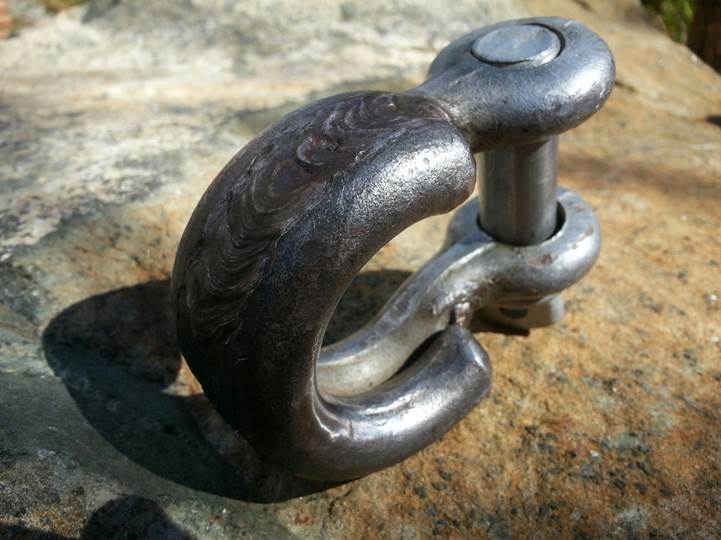
When Glenn Riggs, a tree worker in Pennsylvania, got his first X-Rigging Rings, he contacted me and said he really liked them and shared what he had been using for many years.  It was a clevis shackle that had another clevis U shape welded to it to increase the width.  It was an ingenious homemade tool and it was exciting to find something achieving the similar low cost and adding friction.

pic9 

Clevis donated by Glenn Riggs, PA.


He still uses both the homemade clevis devices and the XRRs.  Doubled up 5/8inch steel shackles have been a part of my tree rigging for two decades.  My number one choice over cheap small pulleys for limb rigging.  The X rings have taken over as my number one in the last two years.  Small, light, super strong.  My son Jake has one always on his saddle for quick lowering…”


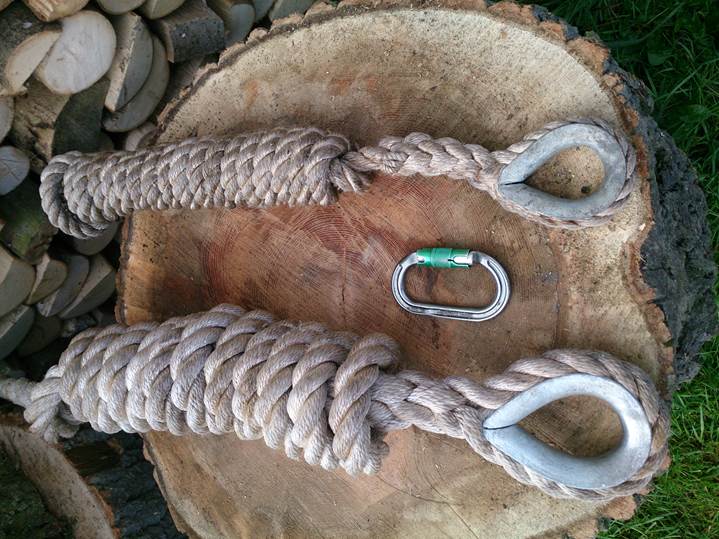
When European arborists saw the XRRs, some informed me that years ago, before blocks, there was this thing they called a strop in Europe.  I was told they were approximately 24mm three strand nylon slings with a spliced eye and metal thimble in the eye for lowering.  The metal thimble looked galvanized.  They said the tight bend radius and friction of the strop often caused ropes to snap.

 pic10

Strop picture, courtesy of John Lawrence, United Kingdom.


In contrast, the X-Rigging Rings are hard-coat anodized machined aluminum, the anodized surface makes it slick and hard as tool steel.  The ring gets its strength from its thickness and more importantly, the sling cordage that fills the groove around the ring.  The hard-coat anodize outer layer is much more effective at keeping temperatures down as compared to steel friction products.


If you have a rigging system of say a large stainless steel Porta-Wrap and X-Rigging Ring slings and you intentionally do a long fast run to abuse and attempt to smoke the rope…..  You will smoke and glaze the rope on the porta-wrap way before the rings ever will.  The rings stay surprisingly cool compared to other friction components in your system.

In the past I used steel carabineers with loop runners on my speedlines.  Those steel carabineers can heat up and can burn a ground person’s fingers while disconnecting them from the speedline.  That’s too hot!  I have also bent them and had gates open up in brush.  I still use the steel carabineers and loop runners on my lightweight speedlines.  But for heavy speedlines and vertical speedlines the XRRs come out to play.    They have less friction, are wider and cooler running than steel or aluminum carabineers that are not hard-coat anodized.


When lowering small to mid-sized limbs, users find that on limbs that would normally be too heavy to handle using a pulley with no lowering device; they can now handle that limb weight with just rings alone. NO lowering device at the base of the tree.  We typically use a ring or two at the top of the tree and a ring as a basal redirect on the average white pine or spruce removal.  That is all the friction needed to lower most spruce and pine limbs.  No need for wraps, no need to ever take it out of the ring. 


Top of the Tree Friction Tools


With the industry slowly realizing that friction is important up IN the tree; I suspect other tools designed to do this will be coming out in the future.


A top-of-the-tree friction device that was lightweight and did not apply too much friction would be a very useful tool.


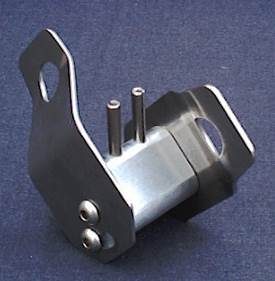
This belay spool might be such a product for light weights:

 pic11

Courtesy of BMS Rescue Equipment


I have heard that some people like this spool for top of the tree friction.  Its SWL(safe working load) is stated as 600lbs.  It was not designed for the arborist industry, but has been adopted by some.   It appears that you attach it with a carabineer.  If so, the carabineer with it’s narrow diameter on the sling would likely be the weak point.  But if following the SWL, this should be fine.


Some existing tools a climber might use are likely already in their tool kit; figure eights and Porta-Wraps.

Figure Eights tend to spin the rope under load, causing weird twists and knots, they also apply too much friction in my opinion. 

Porta-Wrap type of devices with no side plates can lose a wrap with swinging or negative rigging loads.

The Belay Spool (pictured above) has two side plates that come together at the carabineer or shackle attachment point.  I have not used this device, but I’ve heard good reviews for light to medium weights. It uses small diameter rope and is NOT designed for tree work. Most tools get abused by tree workers, so I prefer things that can handle huge weights and abuse but keep the users safe even (if they make mistakes).


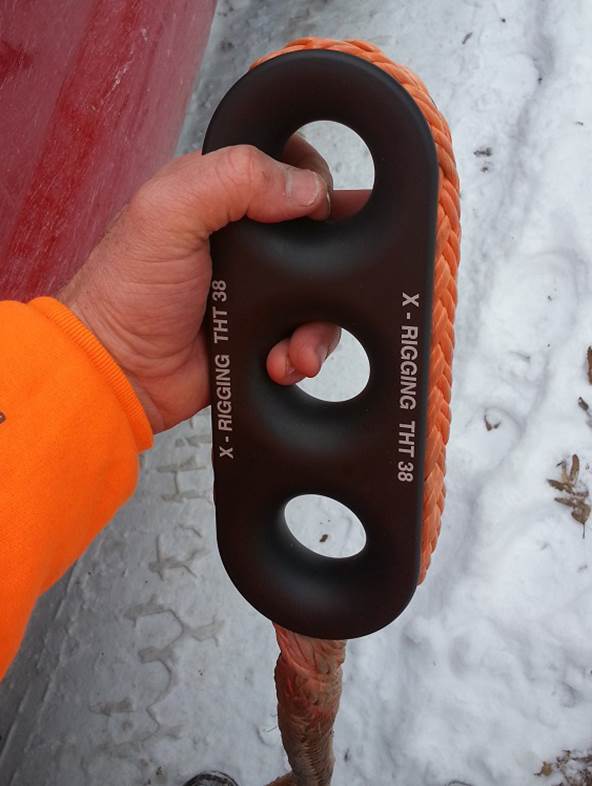
One such product is coming out soon.  The X-Rigging THT (Three Hole Thimble). 


 pic12

Patent Pending THT from Xtreme Arborist Supply.


On medium to large weights, problems such as too many wraps is not possible with the THT.  Also, wraps coming off is not possible with the THT.  The rope can never come off.  The climber adds friction with the THT by weaving the rope through the holes. Using all three holes is never going to add too much friction (for any significant weight) and cause things to lock up/shock load (like too many wraps on a porta wrap). Therefore, it will not stress the short section of rigging rope that I touched on earlier.  If only the slightest amount of friction is desired, two holes can be used instead; or even just a single hole like the XRRs. The groove around the device is the sling attachment (similar to the rings) and actually gives more strength to the tool.  There are no moving parts and it is constructed of solid aluminum.  The aluminum is hard coat anodize on the surface.  There is no circular wrapping like most friction devices. Due to the straight line of friction, the rope does not get kinks or hockels like circular wrapped devices.

It can be used on control-lines as an unmanned friction device to slow down the swing of a load.  When lowering medium sized material with a THT a groundperson can tend the rigging rope while the climber makes the cut as usual.  Then the ground-person lowers the load.  The climber takes over on the rigging line because the THT is creating enough friction and the ground-person is now free to work at laying the load down.  So, not only are you putting less force on your rigging point when using a friction tool at the top of the tree, you often can work with two crew members almost as easily as if you were working with three.  The THT can be used on huge weights in conjunction with a basal lowering device to give friction at the rigging point and greatly diminish the loads on the rigging point.  I particularly use it when compromised limbs are my only rigging choices available.  I feel better knowing that less force is placed on the limb verses if I was using a block and lowering device at the base of the tree.

The THT also creates MORE fiction as it inverts during the transition in negative rigging.

 pic13       pic14

THT prototype in negative rigging.  THT using two holes on limb lowering.  Photo by Xtreme Arborist Supply Inc.


These are exciting times in tree rigging – don’t be left behind.


J. David Driver is owner/president of Arbor-X Inc. A Tree Service in Bel Air, MD,

a TCIA member company since the year 2000.

Also president of Xtreme Arborist Supply Inc.

Treasurer of the Maryland Arborist Association.

ISA Certified Arborist and Maryland Licensed Tree Expert

Check out this video that demonstrates these concepts:

Starting out in Tree Care, Safely

0


Getting your first job in the tree care industry can be very exciting. Entering this new world will be wrought with reward as well as danger, in many forms. The purpose of this article is not to list and detail the risks and rewards associated with this industry, for they are too numerous, but rather to encourage a healthy state of mind in the young Arborist that hopefully will help you to be successful while remaining as safe as possible.  There is a saying that is common amongst tree climbers that will be repeated throughout this article “Slow and Low”. It is the concept of taking things slow and becoming comfortable with a certain task, piece of gear, etc. at a low elevation before attempting to perform at height.

Typically if you are starting out in tree care you are being presented with an “earn to learn” situation, meaning you will be able to learn a new trade while simultaneously earning an income. You will most likely be expected to learn quickly and show that you can work hard and be safe at the same time. It is very important to observe and acknowledge the forces at play around you and communicate with your superiors if you have relevant questions or are unsure of a work practice. Hopefully you will be working with someone who has the knowledge and ability to explain things to you and put your mind at ease. If not you may want to seek the advice of a professional whose abilities and knowledge are proven, also seek to educate yourself.


There are many great resources available to the modern Arborist, depending on your situation, the company that you work for may have many resources at hand or you may have to seek out these things on your own; either way it is important to use every available resource to your advantage.  A valuable text to the aspiring Arborist is “A Tree Climbers Companion” written by Jeff Jepson, which covers many basic terms, techniques, knots etc. that will aid you greatly. “The ISA certified Arborist study guide” is also a great way to establish a solid platform of knowledge to build on, add in “The Art and Science of Practical Rigging” by Peter S. Donzelli and Sharon J. Lilly and “The Fundamentals of General Tree Work” By Jerry (G.F.) Beranek and you will be heading in the right direction.

Excerpt from “A Tree Climber’s Companion”


levi 2

Beyond printed literature there is an incredible amount of information available through on-line forums, YouTube, and many other forms of media. Keep in mind that you must be very discerning while taking info off the net as there are many un-safe practices that can be witnessed through this media. Maintain the “Slow and Low” mindset and you will not be overburdened with information or have an accident trying out a technique that you saw on a YouTube video.

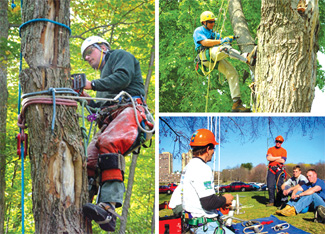
Visiting trade shows and tree climbing competitions is another great way to familiarize yourself with safe and current practices in the industry. Here you will find gear, techniques, and abilities show cased at the highest level as well as educational lectures, seminars and professional demonstrations. There are also many companies, such as Abormaster, which provide hands on training with the best of the best.

Arbormaster training seminar.


arbormaster_7 leviExploring the resources outlined in this article, remembering to watch, listen and converse as well as maintaining a healthy lifestyle and mind set should set you in the right direction for succeeding in the tree care industry. Keep it “Slow and Low” and DO NOT proceed if you are unsure, have fun and BE SAFE!
Rescue Training

0

Rescue

During the winter months when work slows down, it’s hard to find worthwhile events to attend. In 2014 this was not the case-at least in the Northeast.

Brian Noyes of Ocean State Arborist Training created a venue that will no doubt be duplicated in the years to come. His creative approach to aerial rescue training was not ony well-received, but it has left all of the attendees wanting more!


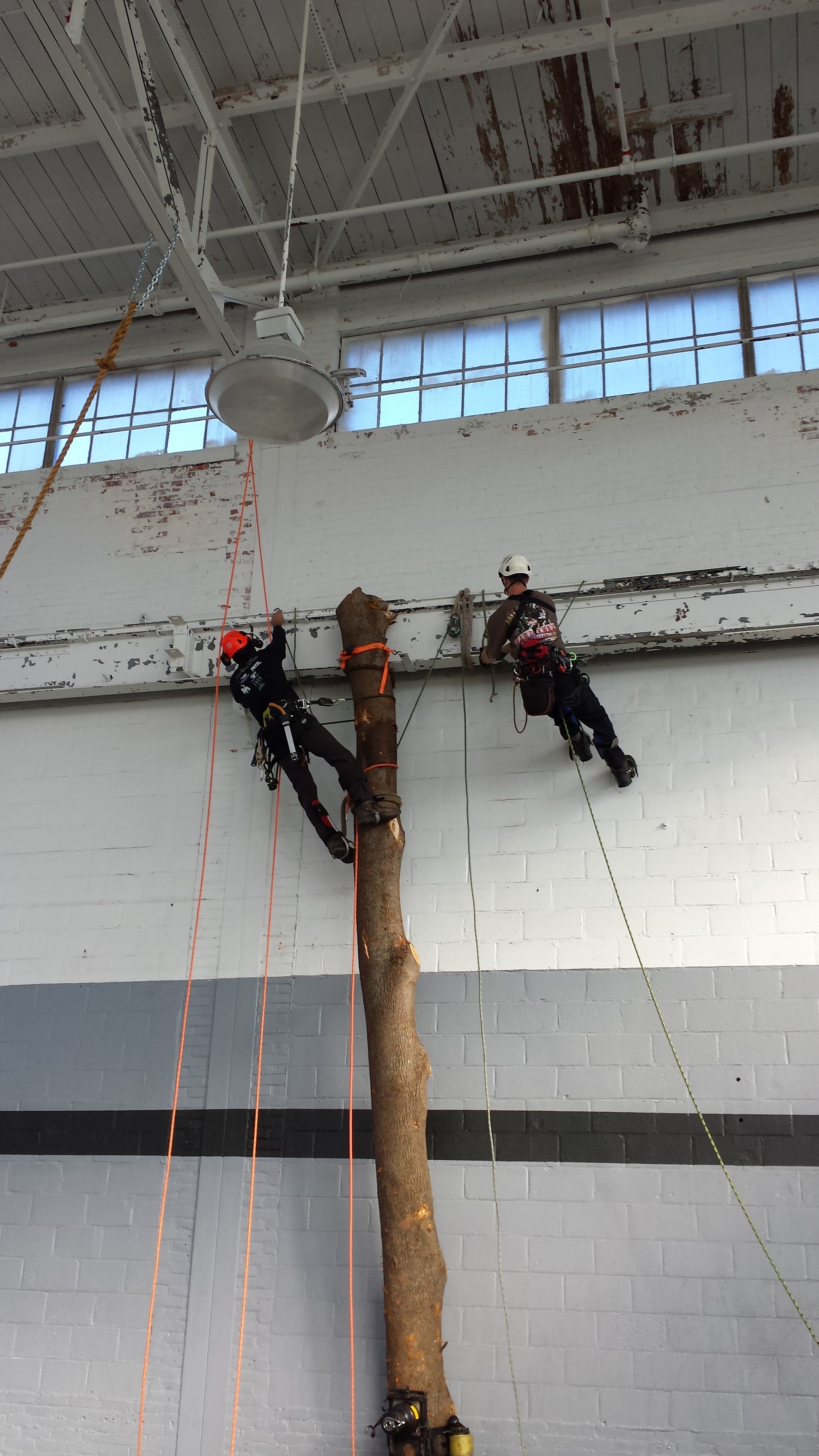
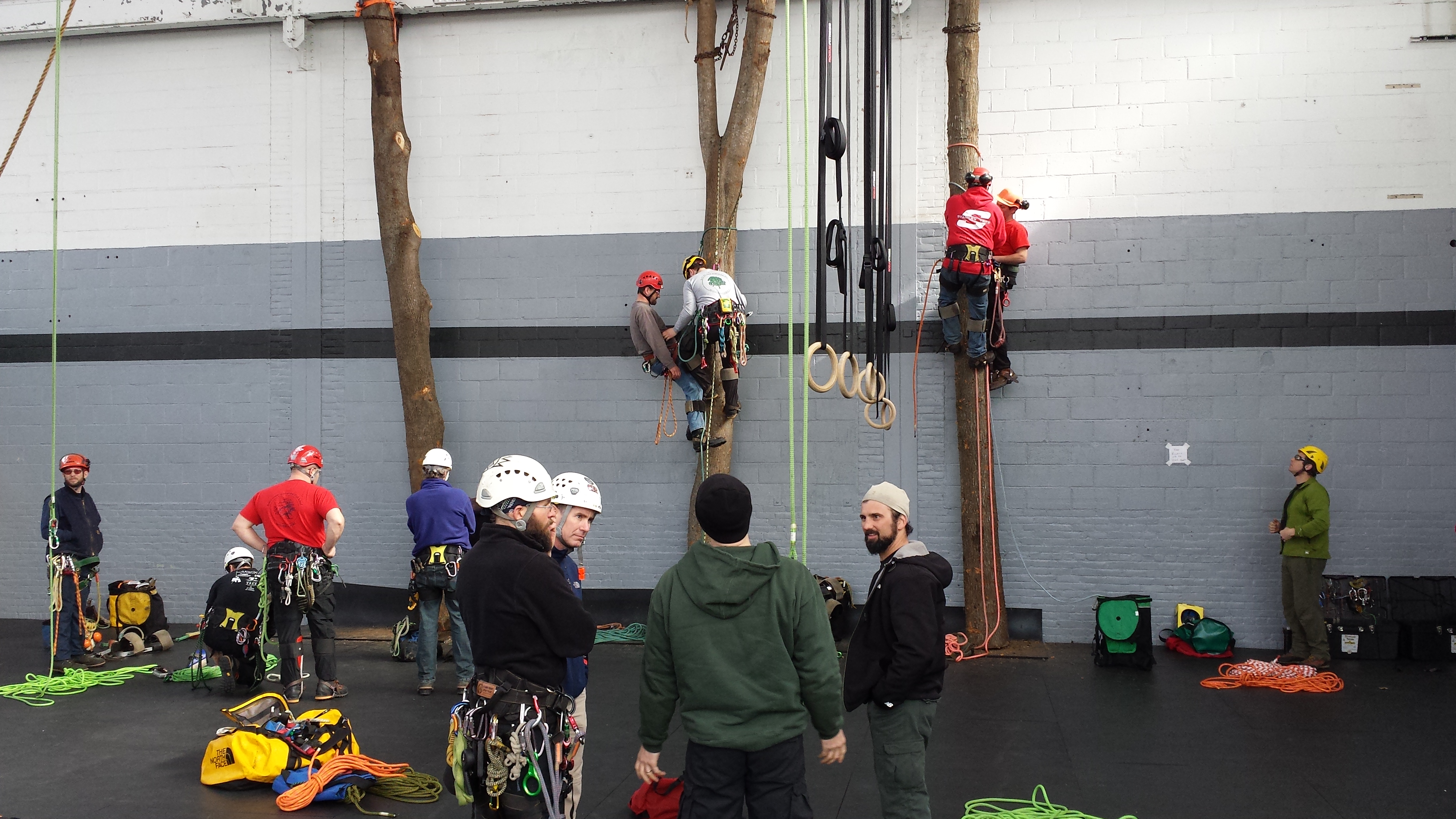
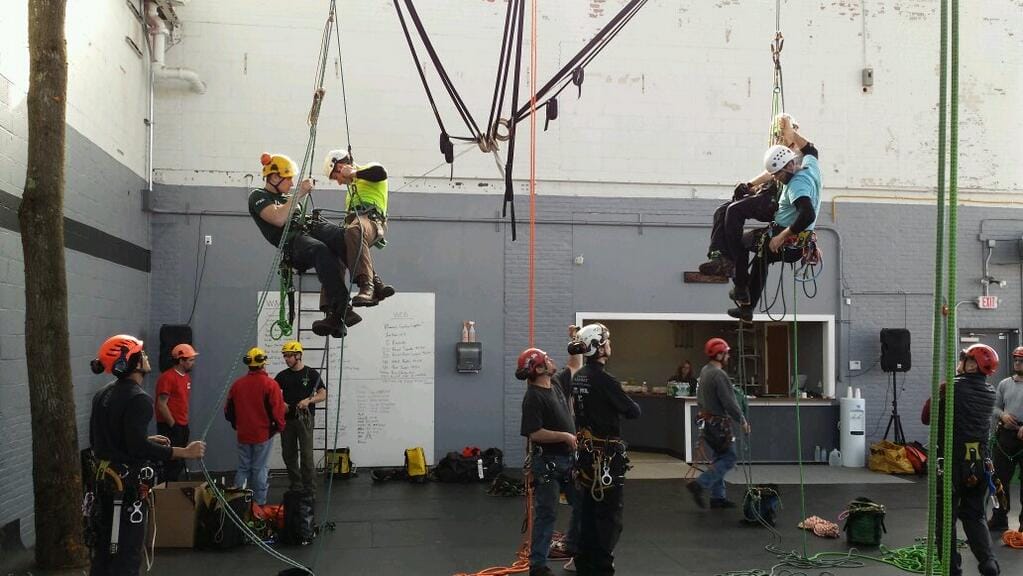
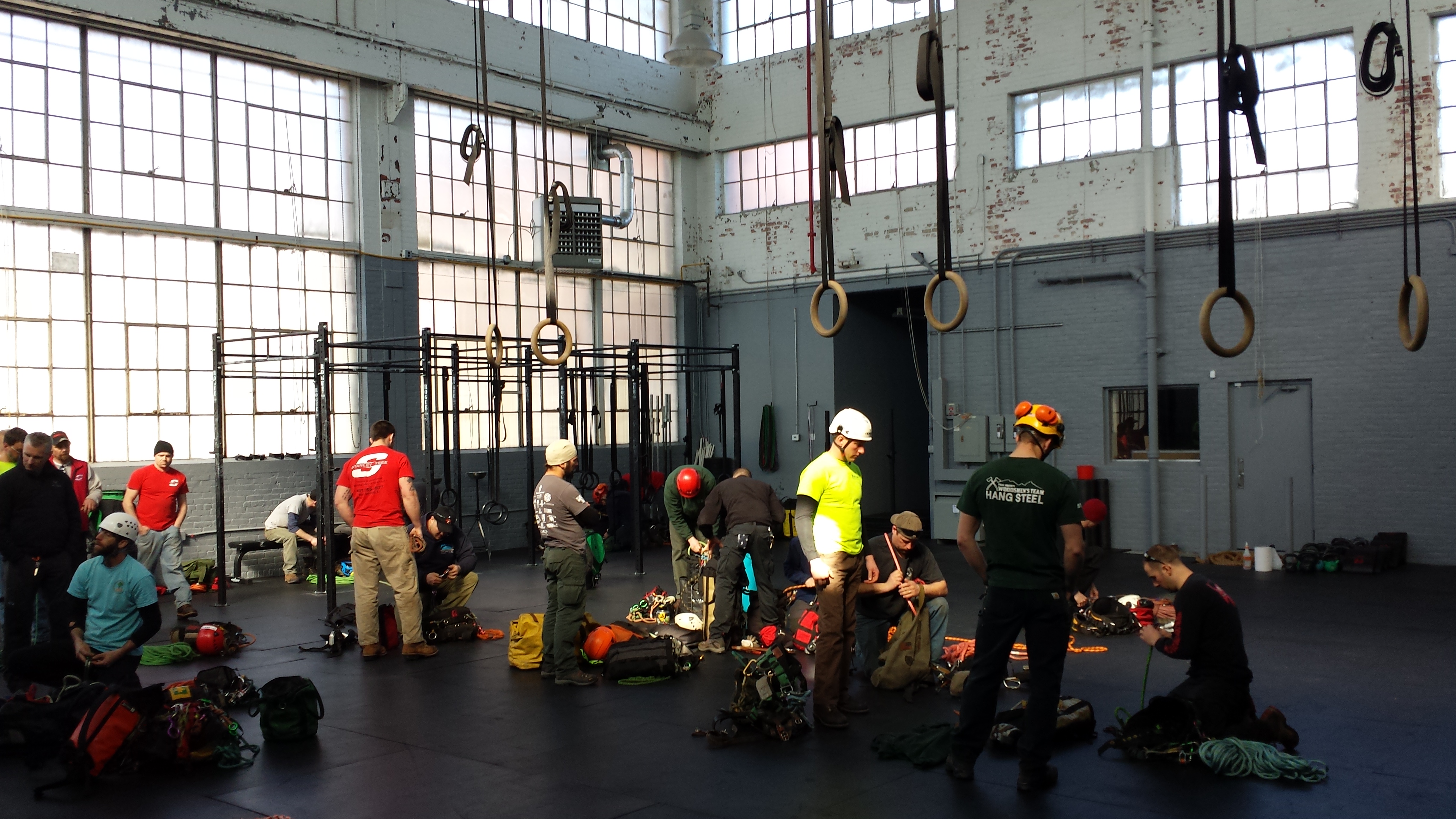
The first thing he did was recruit myself and fellow World Champion Tree Climber Jared Abrojena to help with the instruction. Then he searched for the perfect venue. What he find was a perfect fit- a CrossFit. He contacted his local CrossFit gym and asked if they’d allow such a learning experience in their facility. Why there? First, they had the open space. Second, it had a high ceiling and open steel beams from its previous life of a factory. And lastly, it was indoors in February! Luckily they agreed and the plans moved ahead.


galaxy s4 092

The two-day event was a mix of indoor theory matched with hands-on practical training. The focus was on getting the participants to understand what it takes to control an emergency situation and perform different rescue scenarios. The unique nature of this workshop allowed us to bring actual tree trunks indoors and secure them to the beams and practice spar rescue. Why spar rescue? Because it is one of the hardest to perform and one of the least practiced techniques. We also went through work positioning rescues and ascent rescues, with a focus on SRT ascent rescues.


galaxy s4 100

What Brian did here was fantastic on all levels. I’m so convinced that I will bet you’ll see it offered again real soon!


galaxy s4 098


Ohio TCC

0

Ohio Fall TCC – 2014 – Nick Markley Wins

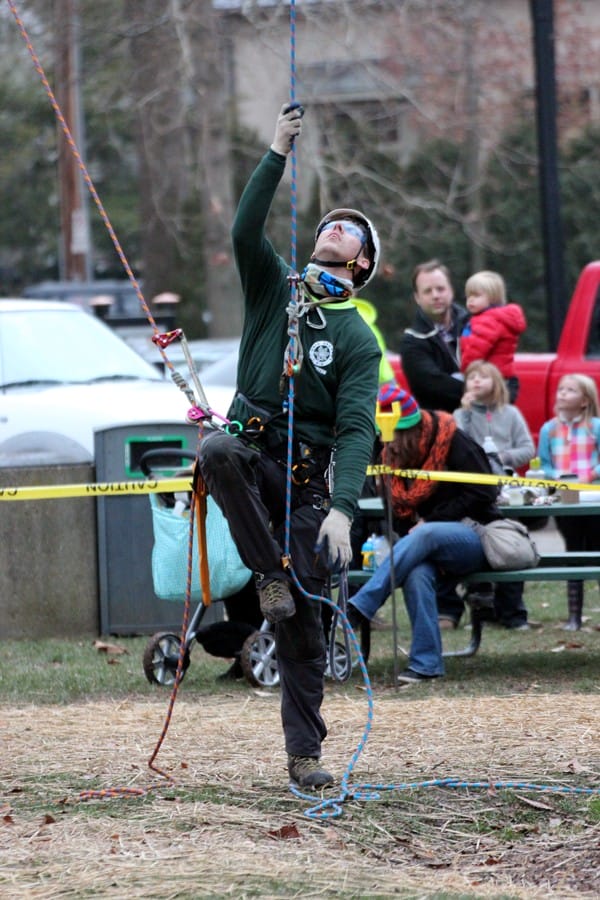
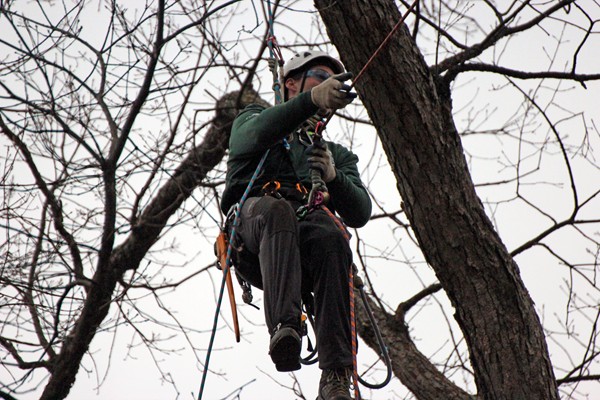
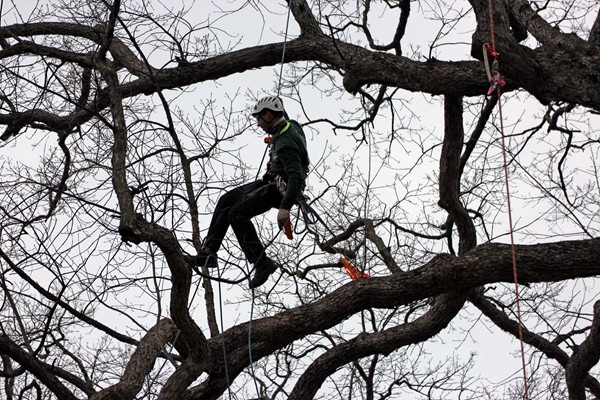
GJM Rev: 141216    1600 Nick Markley won Ohio’s Fall TCC on December 13, 2014 at Jeffery Park in Bexley, Ohio. Nick’s techniques, innovation & “vision-for-the-climb”, are improving by leaps between TCC’s.   In the Master’s, Nick used an innovative combination of 2 separate & independent SRT systems to reach the first 2 of 4 stations. Each system used a Rope Wrench hitch system, with a basal tie to the base of the oak tree. The primary system was installed very close to the Plumb Bob Station, it ran high into a good “high-point / tie-in”, & finally back down to the trunk. His 1st throw line attempt with a Big Shot was spot-on.   A second system was installed, ran close to 1 of the 2 Hand-Saw Stations, & back to the base of the trunk. These first 2 stations were approximately 25 feet apart horizontally, at slightly different elevations, and on two different tree leads. Both climbing systems were attached to his harness at the start of the climb.  (See Photos)

141213 - MC 2a


He ascended on the primary to the Plumb Bob & rang the bell, while maintaining slack on the secondary, as a safety back-up and for efficiency to reach the 2nd station. He disconnected from the primary, to advance around several large vertical sprouts; & then reconnected it.   Next he transferred, mid-air, over & onto the secondary system to ring the 1st hand bell.He transferred back to the primary system.

141213 - MC 91a

Then he abandoned the secondary system from his harness, and ascended to near the “high-point / tie-in”.  After some redirect / rope management, he proceeded to the remaining hand-saw & limb-toss stations.

141213 - MC 93a


The decent & gear removal were very smooth & efficient.   Very Nice, Smooth Climb !

The winners at the December 2014 Ohio Chapter ISA Tree Climbing Championship:

MASTERS’ CHALLENGE

Men’s Division:

1st Place – Nick Markley (Madison, OH)

2nd Place – Justin McVey (Columbus, OH)

3rd Place – Jacob Sauer (Columbus, OH)

Women’s Divison:

Ellie Vosler (Columbus, OH) finished the necessary Preliminary & Masters’ events to qualify for the ITCC.

PRELIMINARY EVENT WINNERS

Work Climb

1st Place – Justin McVey (Hilliard, OH)

2nd Place – Nick Markley (Madison, OH)

3rd Place – Brian Griffith (Loveland, OH)

Aerial Rescue

1st Place – Jacob Sauer (Columbus, OH)

2nd Place – Johnston Duffey (Westerville, OH)

3rd Place – Justin McVey (Hilliard, OH)

Belayed Speed Climb

1st Place – Jeremy Dunivan (Belleville, IL)

2nd Place – Justin McVey (Hilliard, OH)

3rd Place – Jacob Sauer (Columbus, OH)

Secured FootLock

1st Place – O. Gassaway (Athens, OH)

2nd Place – Jacob Sauer (Columbus, OH)

3rd Place – Chris Coates (Odenton, MD)

ThrowLine

1st Place – Jeremy Dunivan (Belleville, IL)

2nd Place – David Meurer (Troy, OH)

3rd Place – Nick Markley (Madison, OH)

Other participating climbers at the Ohio TCC:

Blake Durr (Edwardsville, IL)

Brian Gadd (Milford, OH)

James Hazelrigg (Sunbury, OH)

Daniel Hurst (Dumas, AR)

Ryan Lewis (Chesterland, OH)

Scott Meeks (Columbus, OH)

Eric Moell (Loveland, OH)

Alex Nordquest (Columbus, OH)

Johnny Provenzale (Columbus, OH)

Nathan Smith (Columbus, OH)

Rod Snyder (Hilliard, OH)

References: Photos – Lisa Carrelli-Kraus; Co-Owner of Independent Tree, Newbury, OH Climber – Nick Markley; Independent Tree, Newbury, OH Retired – GregManning – OHTCC Results- Dixie Russell; Executive Director of the Ohio Chapter