Home Blog Page 4

Leadership for Crew Leaders & Managers By Todd Kramer, CTSP
0

In my nearly 30 years as an arborist, I have seen numerous changes in our industry. Our tools are constantly improving for everything, from climbing and rigging to machines like chippers, grapple loaders and all the various types of cranes we can use. These tools can make our work safer and more efficient. Another “tool” that has greatly improved in our industry is training.

At the beginning of my career, there was very little training available; one simply learned from his or her co-workers, eventually trained their newest co-workers and so on. Now training is available on many different platforms, and that is helping improve our industry.

I have participated in and performed many training events over the years, on topics such as climbing, rigging, aerial rescue, crane use and more. These training sessions have helped increase my skills as well as those of others. While performing training at our organization as well as at other organizations, there is usually one piece of the puzzle that is missing. With so many improvements in equipment, techniques and training, one would think that our injuries and incidents would be declining; the truth is, they are not. So what is missing? Potentially, effective leadership.

In reviewing our training documents from the past 20 years, I see many programs based on performing a task that requires one or more new skills. We have a countless number of those and that’s a good thing. How many training programs do we have on leadership? Sadly, we have had three, and two of them were performed by our staff. If this is the case for a company in its 45th year of operation, such as our company is, then I’m assuming we are not alone.

What is leadership

Leadership. What is it? There are thousands of definitions of leadership. I prefer this one, which I’ve honed from others over the years: The ability of an individual to influence, meaning to get someone to understand and buy into, your vision. To motivate, meaning simply to get them engaged and interested. To enable, meaning to give them the tools and training they need. All of these contribute to a common goal.”

There is a theory that has been around for many years known as the Five Levels of Leadership (from The 5 Levels of Leadership: Proven Steps to Maximize Your Potential, by John C. Maxwell).

Level 1 is the Positional Leader. People follow you because they have to. This means that you were put into a leadership position. It is usually the first leadership role people ever have. In our industry, and in the entire green industry, this is very common. We almost always put people into a leadership role because that individual has a skill to get the work done. We often never consider if the person has the skill to lead. “Tom is really good at pruning, he can be the crew leader of the pruning crew today.” I’m sure that has happened to many of us. If people are following you because they have to, you will get the least amount of effort from them.

Level 2, Permission Leader. People follow you because they want to. This usually occurs because you’re a good person and people generally like you. Have you ever worked for a boss you didn’t like? It’s hard to perform for people you just don’t like. A Permission Leader generally has good interpersonal skills and is good at listening to others. They also often get to know the people working for them.

Level 3, Production Leader. People follow you because of what you do for the organization. If you are all in on the company’s common goal and vision and are always working toward that, people will notice and want to join in. These followers are often high performers because they understand that if the company doesn’t do well, neither will they.

Level 4, People Development. People follow you because of what you can do for them. This is a great level. Leaders are putting more effort into someone other than themselves. This is a struggle I’ve seen at mostly larger companies that have been around for many years, like ours. The older, veteran workers have a hard time teaching the younger generation. We had a younger crew leader who all the younger workers wanted to work with. I finally had to ask, “Why do you insist on working with him?” “Because he teaches me how to do stuff instead of ignoring me all day,” was the answer.

Level 5, Pinnacle Level. People follow you for who you are and what you represent. This is a very difficult level to reach. It is often reserved for Fortune 500-type companies with incredible leadership reaching out to thousands of workers.

Factors in leadership

Management: It’s simply the ability to organize resources and coordinate the execution of tasks. Management involves hard skills such as scheduling, staffing and project analysis, making sure jobs get done on time and on budget. These skills are necessary for any company to be successful. Do these skills influence, motivate and enable staff? Depends on how one goes about it.

Leadership: Soft skills

These skills are once again to influence, motivate and enable staff. Leaders are also very good at stress management. They control their emotions so as not to create anarchy when things are going sideways.

Leaders are also good at team building. They make everyone feel like they make a difference and are contributing to the common goal.

Leaders set the tone. Their presence makes for a positive environment.

Leaders spend time and energy for others.

As a leader, you are generally responsible for the people, not the actual work to be done.

As a leader, you only have one thing, and that is followers. People often volunteer to follow because they are curious about where you are going to take them.

The best leaders also are very good at explaining the “why.” Understanding why staff needs to do a task in a certain order or following a procedure is very important. The days of “Just do it the way I said” are long gone. People need to know why.

The Boss. A boss often drives his or her workers, depends on authority and inspires fear. A boss will say “I” and not “we.” The boss will fix the blame for a breakdown, while a leader will actually fix the breakdown.

We are in the service industry. I’ve been on job sites where the client or a neighbor comments, “Wow, that looks really hard.” I always respond, “With the right training and equipment, it’s really not that hard.” In reality, leading the people is harder than doing the crazy tree work we do.

Whether you are a leader in a company of five people or 500 people, you are not in the tree business, you’re in the people business. People are our biggest asset, not the new chipper, truck, crane or facility. As leaders, it’s important that we listen, observe and learn from our staff. If we don’t understand our staff, they will never follow.

Being in the people business, it is very important that we learn to listen.

Active listening is a skill that needs to be practiced. I’ve sat in many meetings discussing how to improve and most people involved are listening to know how to respond, not to understand. We’ve all been there. In an argument with a friend or family member, often we are not listening to understand but simply to be able to reply for our point of the argument. This does not work as a leader. Leaders need to listen to understand and not to reply. This may involve asking questions and gathering all the information available.

Coaching is a very important skill for a leader. Leaders must know that teaching a skill takes time, and coaching is a fundamental skill that is required. Coaching is the foundation for continuous improvement. Just because you said it needs to be done this way from now on doesn’t mean it will happen. Staff will need to be “coached” into reaching that common goal.

It’s very important as an organization to identify poor leadership. Here are a few clues. A leader:


has a poor understanding of people. That’s not good, you need to understand the people you lead.


feels secure and satisfied. “I’m all good, I don’t need to improve.”


is not organized; is defensive, fights change and has no team spirit.

Those are all signs of poor leadership. With poor leadership comes poor performance out of the staff.

Attitude. Our attitude is one of our most important assets as a leader. Remember, leaders set the tone. If one has a poor or negative attitude, odds are the rest of his or her staff will feel and behave the same way. We are 100 percent responsible for our attitudes. During the day, any number of unplanned challenges can occur to which our reaction defines the outcome of the events. 

We’ve all heard the expression “attitude is everything.” I would have to disagree. Attitude is very important, but not everything. We could have staff with a wonderful, positive and engaging attitude who are also completely incompetent. We could have very competent staff with a poor attitude. As leaders we need to balance and coach staff to improve.

Delivering a Message. How one delivers a message is incredibly important. Here is a theory on how people receive a message: 5 percent is the actual words one uses, 38 percent is in the tone of your voice, and 55 percent is the body language used. Non-verbal communication speaks loudly. Now consider delivering a message over the phone. The tone of your voice is very important and could reflect your attitude at the moment. That could have a positive or negative effect on the person receiving the message.

Trust. Without trust, you will never be a leader. Trust is the foundation for leadership. To help gain trust, leaders first listen, demonstrate respect, show loyalty, have very clear expectations and are extremely consistent in their performance. Please consider that you cannot make somebody trust you. Trust is a feeling, an emotion. It is built on a common set of values and beliefs. Followers feel like they belong and are part of something special. Followers also feel safe – safe that they can make mistakes, safe that their job is secure and safe that they can think independently. In our industry, followers feel safe when they have the correct tools and training to do the job at hand.

As leaders, we need to give credit for suggestions, encourage others, coach staff, ask their opinions and give positive feedback.

Leadership skills are no different than arboriculture skills. Poor performance needs to be identified by the person, then they need to practice those skills to improve. Workers don’t become great overnight. This takes time. Becoming a great leader also takes time. First you need to identify a weakness, then you need to take steps to improve upon it.

Todd Kramer, CTSP, is director of field operations/education for Kramer Tree Specialists, Inc., an accredited, 30-year TCIA member company based in West Chicago, Illinois.

This article was based on his presentation on the same subject at TCI EXPO in Columbus, Ohio, last fall. To listen to an audio recording of that presentation, go to this page in the digital version of this issue online, under the Publications tab.

*this article first ran in the June 2018 issue TCI Magazine and is reprinted with permission
Digital Marketing Tips For Tree Service Companies

0

Digital marketing has become an essential part of any business strategy and the need for this is only going to increase going in to 2019 and beyond. Working within the tree industry one thing I see is that many Tree Service companies seriously lack in their digital marketing efforts. More and more people are going to Google and Facebook to find services, this is no different to the tree industry. This affects arborists and tree service companies in the exact same way that it affects any other business. Today, we are going to be talking about the most important digital marketing tips that you can implement to your campaigns and start seeing results in 2019.

  1. Learn all you can about your local competitors

This is probably the most important thing that you can do with your marketing campaigns. It’s very important to find out how your local competitors are approaching their marketing strategies. Do a local organic search on your services and see if you are anywhere on the first page. If not, you still need to do this to see what the results bring.

You need to take note on the local providers and check their website, their social media and their presence. Compare your prices, your service offers, and your website to theirs and see where you could improve things for optimal results.

  • Optimize your website

Being able to optimize your website in every possible way is always going to be important. The first thing to consider is your website’s responsive features. A website that is not responsive and optimized for mobiles is going to lose more than 60% of their potential customers. Most people are using their mobile to browse the web now.

The loading times on your website are also very important. Any website that takes longer than 3 to 4 seconds to load is going to have a significant increase in bounce rates. If it takes more than 5 to 6 seconds to load, the resulting bounce rates will be devastating to your conversions. Make sure that your images and header are optimized. It’s important that your content is not causing slowdown on the loading times.

  • Work on your Google My Business listing

Being able to keep track of your Google My Business page and your customer reviews is going to be very useful. If you haven’t listed your site with this service, we suggest you do this as soon as possible. Be sure to avoid any duplicate listings if you want to have optimal results. There are plenty of tutorials online that can help you make the most out of this powerful Google feature.

  • Create engaging blog posts

This is probably the most important aspect of marketing after optimizing your website design and loading times. Once people enter your site, you need to make sure that they will be able to find useful content. Content marketing continues to be king when it comes to organic growth, so make sure that you take the time to create valuable posts that people can use.

Tree service companies can give people tips on how to take better care of their plants, what kind of things to do for maintenance after a tree service provider does their job, etc. There are many ways to give people free and valuable information while still encouraging them to hire your services.

Consistency in your blog posting habits is essential, but quality needs to be your priority. This means that you have to focus your efforts on delivering good content even if his means you won’t be posting too often. One valuable blog post per week is going to be better than five mediocre publications.

  • Engage your audience with videos

Video marketing has turned into one of the most powerful ways to promote a business. People who use mobile devices to browse the web prefer videos with audio. They are more likely to watch a video than they are to read a text article. Luckily, you can also create live streaming videos and promote certain discounts or even show people how a job is done. Either way, videos are always an amazing way to get more people invested in your business.

Create a newsletter and encourage signups

A good way to do this is to offer a free guide or small eBook related to tree maintenance. Even something as small as 10 essential tips on gardening could be an amazing way to achieve results. Give something for free or offer discounts to newsletter subscribers and you are likely to get more people to sign up. The important thing is to make sure that people can find a valid reason to give you their name and their email.

  • Focus on a single social media page

Normally I am a huge fan of going for an omni presence. However, if you don’t have the time or resources that these social media platforms need, it would be best to focus your energy on one platform. If you had to choose between one form of social media I would suggest going with Facebook. The best thing about Facebook is you can merge all the content you post to be reposted onto Instagram. Facebook is always a great way to find people in need of your services. Facebook advertising is also one of the best going around today.

  • Find local influencers in your niche

Any influencers that have any kind of home improvement, gardening and general lifestyle niche audience is going to be very useful for you. A popular influencer could bring in thousands of potential customers to your website and social media page with a single shoutout. 

  • Focus your targeting on local results

Given that this is usually a service that is given locally, the best thing to do is to target local searches. Consider the most popular keywords that are being made by people looking for your services and use those in your content. Always in moderation of course.

Final thoughts

The world of internet marketing is one that continues to grow day by day. It’s very important for people in any kind of business to implement these marketing strategies. Services that can’t be provided digitally should always focus on local results.

Don’t’ forget that your marketing efforts need to be constant. Even if you manage to achieve a good rank or gain a large following, you won’t maintain it if you stop creating content and engaging with other users.

Adam Stewart – Digital Bond Marketing

Face-To-Face Matters

0

Face-to-Face Education Matters: Instructors Make the Training

Alex Subak, School Director, ACRT Arborist Training

In my role as School Director, I frequently encounter resistance to the idea of in-person training. Besides the cost of the training itself, employees have to take time off work to get the training, there might be transportation costs as well as lodging, and employers worry about the efficacy of the whole endeavor; do I really need this training? What will my company get from this? Can’t we just do this online? I will answer the stated questions and reiterate while face-to-face training still matters as we move into a digital future.

First of all, my aim is not to impugn or disparage the state of online learning or training. With the ubiquitous nature of the Internet and a general connection to the online world in all facets of our lives, it would be foolish to not leverage online resources. In my industry however, a very hands-on industry, the need for face-to-face training is still paramount.

Being able to make the proper cut when removing sections of a Red Maple becomes very important when you realize a six-foot section can weigh as much as 800-1000lbs. When we take into account that an arborist might be 50 feet in the air when he makes the cuts, and that each tree they are working on could have a different challenge or unique character, we can start to see why a video explaining how to make the cuts may not satisfy the safety training arborists are required to go through. If you were up there and planning where to drop the log, would you be comfortable knowing it would happen just as it happened in a video lesson?

I use online resources, including documentation and videos, to help supplement the training that we provide to our clients. These are important aspects of the training, but the most important part of the training is not the equipment, the price, the weather or what books are being used; it is the trainer themselves. Time after time, the reviews for the training we provide state that the instructor made the training, that without them, the class would not have been the same. Typically supervisors and office managers ask for the same instructor time and again for future trainings, and it starts to become a challenge trying to fit everything on their schedule! But that is a good problem to have.

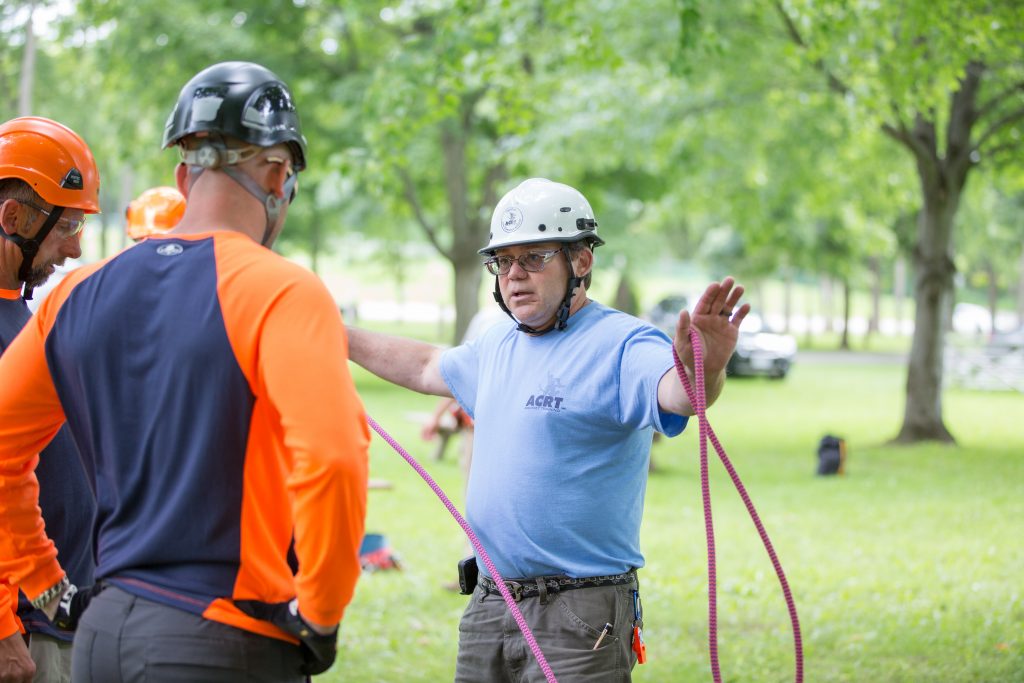
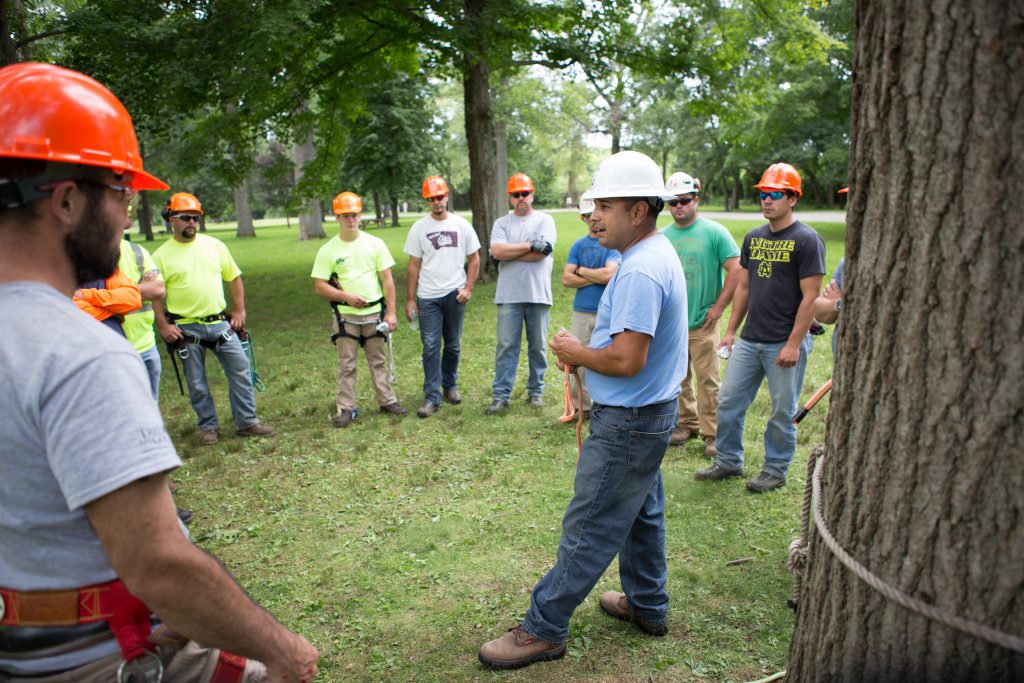
My company provides a product and we aim to provide the best product we can. Face-to-face training is essential in our business because it is such a tactile industry that depends on a physical exchange between an arborist and their work. We find that many of the students in our classes and participants in our trainings have a mind for tactile learning as well. Having the instructor there to tell them how to do a task, to then show them the task, and finally to guide them in completing the task is a benefit to their learning process. Without an instructor in the field with them on even in the aerial lift while they plan their cuts, an essential component of how they will complete their job is lost. What you get from us is a dedicated instructor, a boot on the ground, an expert resource to consult in the extremely important world of safety concerns in our industry.

To follow up the idea of safety, one question still remains unanswered; do I really need to have this training? The answer lies in the ANSI Z133-2017, the standards for Arboricultural Operations and in the pages of OSHA documentation on the subject. And the short answer is yes, you have to provide training for your employees, and the amount and type of training has to be appropriate for the work they are going to be doing. If they will be working within 10 feet of an energized object, they have to be qualified to do such work and trained in the nominal voltage of lines they will encounter. In my line of work, I have encountered many crew leaders and supervisors who know they need the training but can’t quite make out what exactly they need.           

Our instructors are experienced, professional, safety-minded, and committed to teaching all arborists in their training classes the skills they need to know. They serve a vital role in an ever-increasing digital world; a physical presence who can guide a new or a seasoned arborist through the dangerous work that is a hallmark of the industry. When training is mandated and safety is the goal, having a trainer in a face-to-face setting can be the difference in seeing what you should do in an emergency and knowing what to do. Even when we don’t end up doing a training class for a client, the instructors are committed to following up with all inquiries and working to promote safety and training in their daily lives. Physical instructors have been an important component of the industry for years and will continue to be important even as we move into an online future. 

Alex Subak finished his Bachelor of Arts degrees in English and History from Kent State University in 2008, and he later completed his Masters of Arts in Teaching (MAT) and received his teaching certificate. Knowing how information is and will be transmitted, he took a teaching position at an online school and taught there for 6 years. Alex has been with the Arborist Training department of ACRT for a year and looks forward to being instrumental in the conversations about how training is delivered in the modern corporate environment and how adults can be best guided to complete their work safely and effectively.  

The Bore-ing Back-cut…

0

The Bore-ing Back-cut…

The Bore-ing Back-cut…

by Tim Ard, Forest Applications Training, Inc.


Once you have completed the first four areas of information on your felling plan it is time to choose a back cut to fall the tree. You may choose to simply start from the back of the tree and cut to your holding wood/hinge or you might bore-cut through the tree, set up your hinge then cut backwards to release the tree. Yes, there are several other configurations of cuts that could be made to conclude the process. You could cut the good side, then the bad side, from back to hinge or hinge to back. You could bore and circle the tree with the back cut. But, what is or are the advantage(s) of a bore-cut over the simple back cut?


When asked the question of the advantages of the bore-cut I usually explain that the only negative to the bore-cut, if it is one, is the understanding of the reactive forces, especially the one of kickback. Really, if you understand that reaction, there are no negatives, only positives. Knowing how to begin the cut with the lower portion of the bar tip and quickly burying the tip in the process, eliminates the issue when you think about it. So, let’s list some positives…


1.      It reduces the chances of the tree trunk barber-chairing in heavy forward lean.

2.      Allows for a planned hinge/holding wood dimension to be better achieved. 

3.      Makes it possible to cut larger trees with multiple position (side to side) cuts.

4.      Improves capabilities of using a shorter saw bar length on larger trees.

5.      In smaller back leaning trees it gives the ability to place wedges before setback.

6.      Controls the release of the tree when there may be widow makers or broken tops.

7.      Gives more escape time from trees with vine issues.

8.      Offers better footing and escape from trees in steep or slippery terrain.

9.      Reduces fiber pull on the stump by allowing more accurate hinge completion.

10.   It offers the ability to locate hollows and rot areas in the tree trunk.

11.   Enables better controlled release of the tree should there be traffic or people issues.

12.   Eliminates some issues with tops swaying or wind effecting the release of a tree.


There are probably more as I sit and think and there are also several advantages working with bore-cuts on horizontal storm damaged trees. The Bore-Cut is not so boring… but very useful and productive.


Check out other articles on www.ForestApps.com and www.ForestApps.Blogspot.com And if you are interested in finding out more of having Forest Applications Training, Inc. take part in your chainsaw training programs or presentations contact us at info@ForestApps.com .


Chipsafe

0

Be Safe. Get Chipsafe.

Here is what people have been saying:

“This device will stop the infeed if you put your hand or foot in the infeed chute past the safety plane. It is easily restarted if you do trip it, virtually not losing any productivity, and most importantly, keeping the operator safe“

— Jeff Buchanan Tree Service

 “The safety device is a good tool to keep guys from getting too close to the feed wheel. Plates are a very good idea.”


— J. Johnson

— Kappen Tree Service

In an industry that has intrinsic risks, arborists and tree care workers must be conscientious in following safe operating practices when using heavy industrial wood chippers. Such practices include never operating a chipper alone and always wearing Personal Protection Equipment (PPE). In addition to the typical PPE items like head, eye, and ear protection, Morbark now offers the patented ChipSafe® Operator Safety Shield.

Here’s how it works:

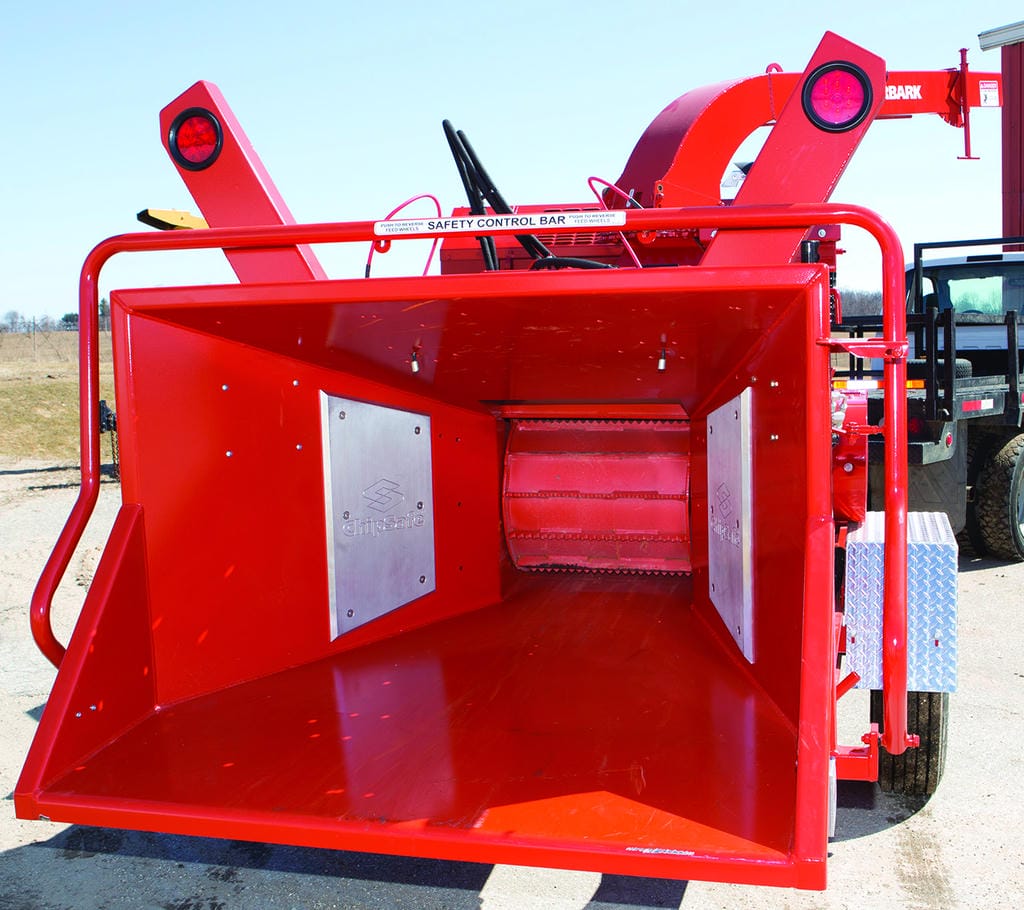
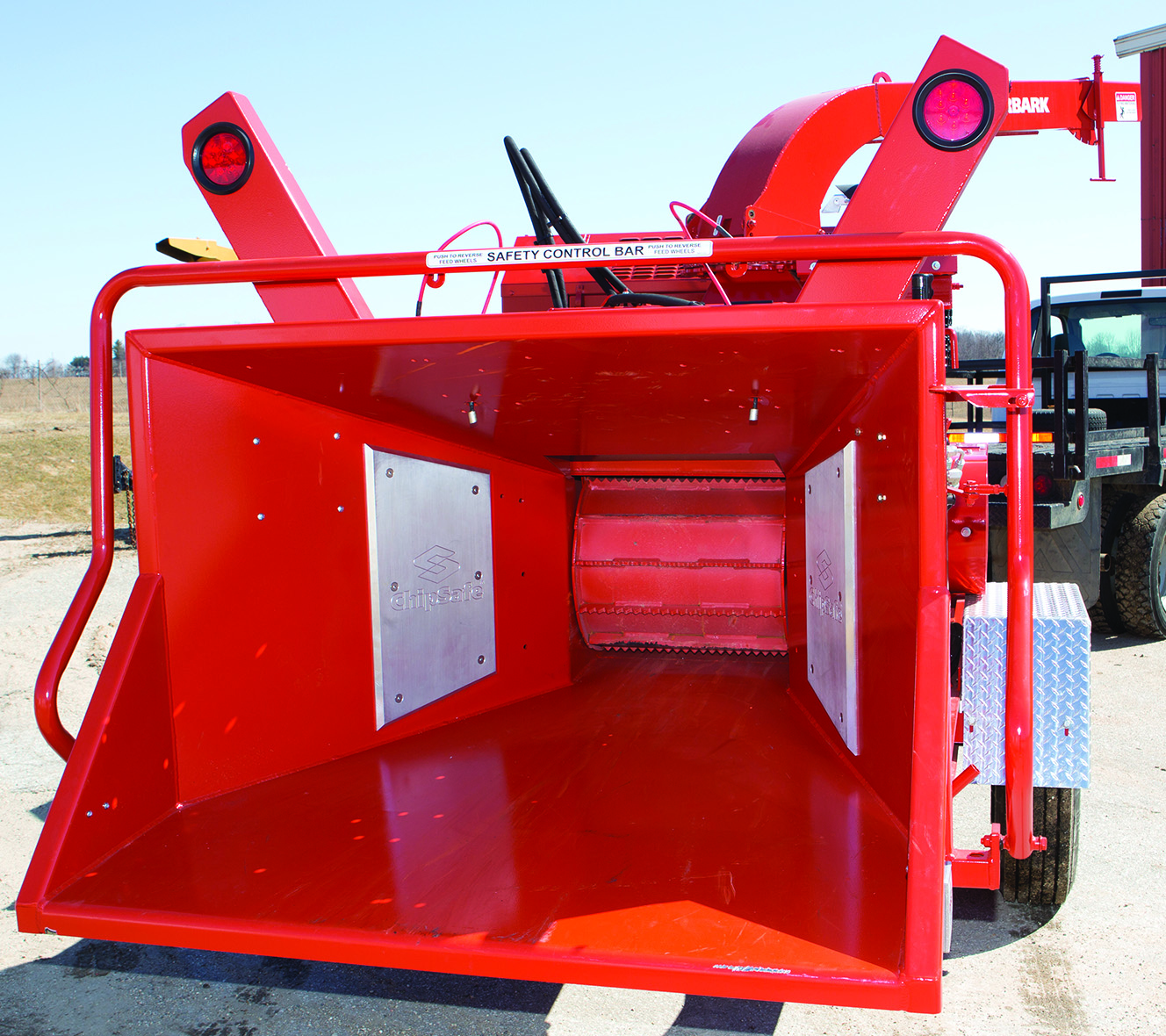
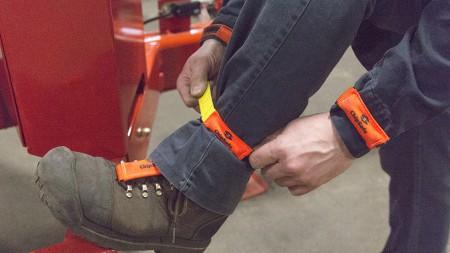
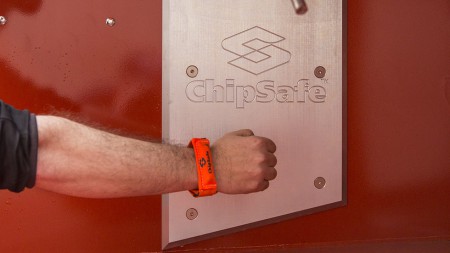
The ChipSafe Operator Safety Shield device is mounted directly to the sides of the infeed chute of a Morbark brush chipper. When preparing to use a brush chipper equipped with the ChipSafe device, operators must wear ChipSafe straps on their wrists AND ChipSafe straps on their ankles or ChipSafe bootlace straps on their boots. If, while feeding the wood chipper, the operator’s hands or feet enter the defined ChipSafe sensing zone, sensors in the plates send a signal to interrupt the chipper’s feeding mechanism, protecting the operator from possible injury.

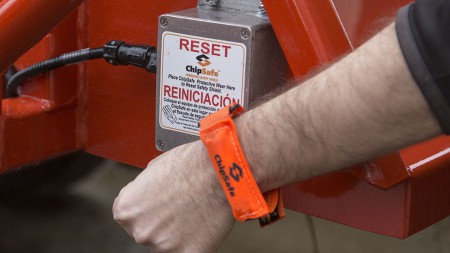
A reset sensor box is located on the outer sides of the infeed chute. By simply swiping the strap on their wrist across the reset sensor box, the operator is able to reactivate the feed mechanism and continue the chipping operation with little or no disruption in productivity.

For complete ChipSafe operating instructions, refer to the operator’s manual. In addition, we highly recommend that all members of your chipping crew complete the Tree Care Industry Association’s Chipper Operator Specialist credentialing program.

If you want to learn more checkout Global Machinery Sales

To Splice or Not to Splice? SRT & Non-Spliced Climbing Lines

0

To Splice or Not to Splice?                                                

SRT & Non-Spliced Climbing Lines

Marlow Ropes’ range of CE certified and ANSI compliant climbing, rigging and accessory lines are field proven and trusted by Arborists worldwide and manufactured in the UK under rigorous ISO 9001:2015 quality standards.

Whether it be hard wearing arboreal tree climbing ropes, super strong slings and throw lines or heat resistant accessory cords for prusik loops and friction hitches, Marlow excels in arborist equipment design, quality and performance.

A question that we are asked is whether climbing lines should be spliced or not. As manufacturers of both options we see the benefits of both, but have seen the significant rise in Arborists using Single Rope Technique (SRT) in the industry, and therefore the changing nature of the ropes they are selecting for the job. There is becoming less of a need for arborists to always use the spliced option.

In SRT the rope isn’t terminated at the harness which eliminates the need for a splice. Normally the argument is that a splice is smaller or slimmer and therefore keeps the harness area uncluttered, but this only matters if you are using the Double Rope Technique (DRT).

Non-spliced climbing lines, such as our recently launched VEGA hold many benefits:

* Non spliced ropes offer more flexibility for climbing from either end. This prevents one section of the rope getting more wear than another.

* Non spliced ropes don’t need to be anchored at the end, in a short tree you could tie the rope in the middle, this further spreads the wear.

* No splice means no diameter change. This means the rope is easy to thread up in ascenders and other rope control devices. It also makes rigging and retrieving easier, nothing to snag and can be rigged from either end.

* No splice means a bit of damage near the end of the rope can be simply cut and re-sealed / labelled and the rope is ok for further service (albeit a little shorter).

* Ropes wear in the eye- in a splice that’s always at the same point. In a knot it moves every time you tie it.

Marlow’s new Vega is a CE EN1891 light-weight climbing rope, that currently boasts the lowest elongation on the market (1.2%). Designed specifically for the new generation of mechanical climbing devices and modern climbing techniques.

Vega has a tough polyester core that provides extremely low elongation whilst also being energy absorbing, ideal for SRT climbing. The 24 plait polyester jacket gives a rope with exceptional flexibility and handling without compromising on durability.

Available in lime or orange. Look for the Marlow Black Marker.

2018 TREE Fund Golf Outing NJAISA

0

NEW JERSEY ARBORISTS

INTERNATIONAL SOCIETY OF  ARBORICULTURE  

PRESENTS THE

2018 TREE Fund Golf Outing

PEBBLE CREEK COUNTRY CLUB

40 Route 537 East, Colts Neck

Tuesday, October 2, 2018

Registration& Breakfast 7:30 – 8:40 am / Lunch 2:30 pm

Shotgun starts at 9:15 am!

SEE THE ATTACHED REGISTRATION INFORMATION TO SIGN UP AND SPONSOR THE EVENT – Sign Up On-Line At:NJAISA.com

We once again invite you to join us at the annual NJAISA Golf Outing, held this year at this new location: PEBBLE CREEK COUNTRY CLUB in Colts Neck, NJ. This picturesque 18-hole championship golf course was designed by legendary course architect Hal Purdy, Pebble Creek Golf Club provides golfers with an enjoyable and memorable experience. The unique characteristics and differing landscapes of each hole present a challenge for accomplished players while remaining player-friendly for beginners. This year’s proceeds will benefit our bi-annual chapter challenge goal for the Tree Research and Education Endowment (TREE) Fund

Accepting Single Player sign ups this year – Team up with other members!!   or

Sign up with your clients!!! Clients and Arborists perfect together!

Lets make the Golf Outing a great success for the TREE Fund