TCIA Fatality And Near Miss Report
We kindly ask that you take time to review the incident(s) below and consider using it as a basis for, or incorporation into, a tailgate safety meeting. You may also consider posting the notice in your shop.
It is our hope that you will take some action with this notice as you deem appropriate for your company.
The following is from the news report, and is not a TCIA statement:
Man electrocuted in Cape Coral
Cape Coral, Florida
A man was electrocuted and died, Saturday, while he was trimming a tree for a client on Vendome Court, off Cape Coral Street.
This report was published May 27, 2017 by fox4now.com Full Report
The following is from the news report, and is not a TCIA statement:
Wife heartbroken after husband killed in tree trimming accident
Dekalb County, Georgia
A wife and mother of four is left with more questions than answers after her husband was killed cutting down a tree.
This report was published May 30, 2017 by wsbtv.com Full Report
|
||||
| Most incidents will have enough information and photos or videos to facilitate safety discussions with employees. Some may only be a notification of fatality with limited details, but will help to remind employees of how critical safety is in the tree care industry. You may also review the next issue of TCI Magazine for a full list of accident briefs for the month.
Please note: The incidents chosen for notification are only a sample of events and are related directly to commercial tree care. They involve fatalities, and on occasion near misses with rescues. We believe they will help you facilitate safety awareness and training. They will not and cannot cover all incidents affecting commercial tree care.
If you are not sure how to use this information for safety training or want to learn about TCIA’s safety training program, call us at 800-733-2622. |
Working w/Cranes: What You Need to Know
Working w/Cranes: What You Need to Know
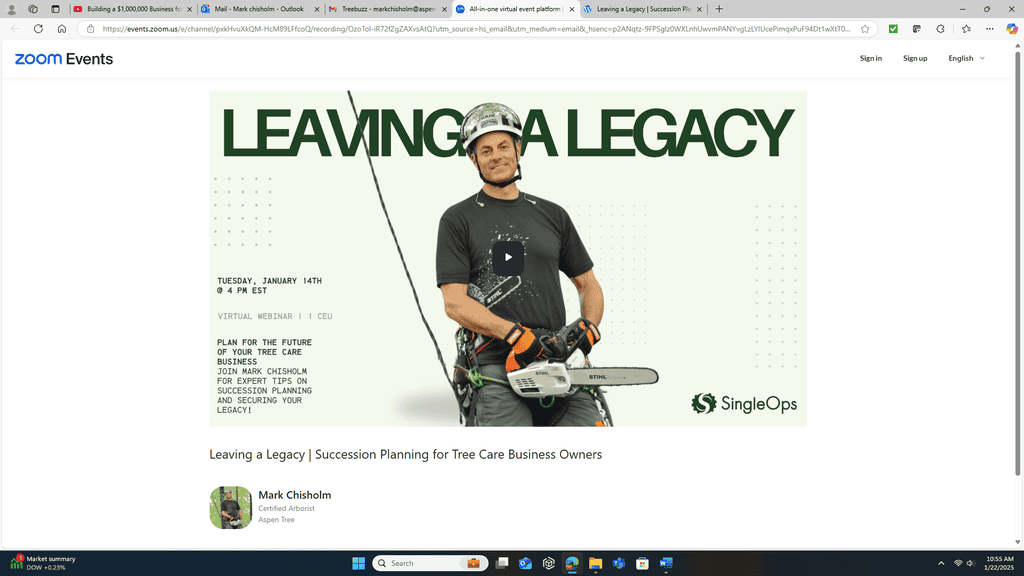
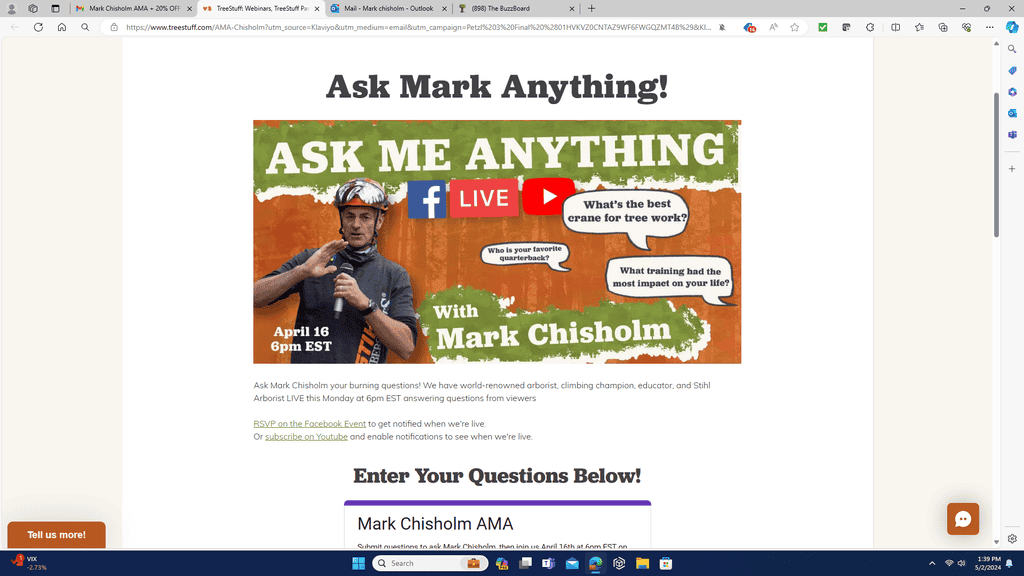
By Mark Chisholm
Should we mention that it was taken from my presentation?
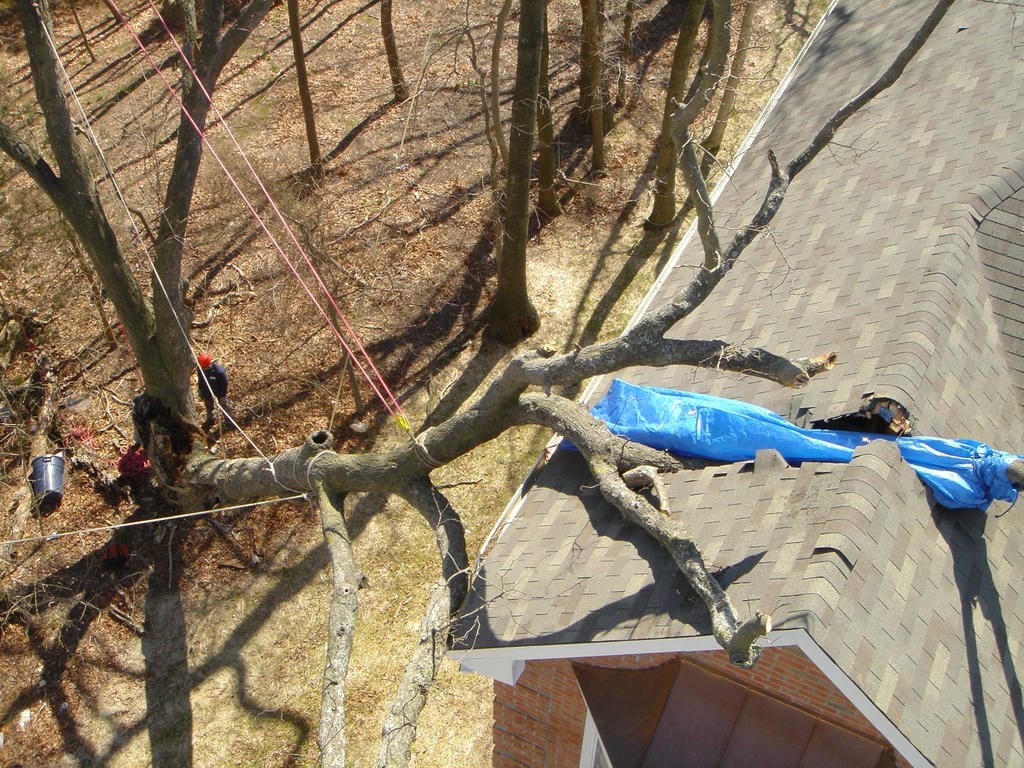
This article is about what it takes to do crane work from the perspective of the person doing the rigging, making the cut, whether climbing or using a bucket truck, and the crew working the ground.
Why use a crane?
Why do you use a crane and why would you want to bring a crane to a tree site? There are many reasons, but I’ll focus on three.
First and foremost is a lack structural integrity. When you have a tree that is very hazardous, a crane is one of the best ways to mitigate that risk. Bringing a crane to the site can make the process safer and simplify the job where you may otherwise be risking your life.
Number two is you don’t have a high leverage point. A lot of trees we get into in the field have been storm damaged or topped previously or have something wrong with them up high and you don’t have a rigging point or a tie-in point you can utilize, and you may need a high leverage point to be able to navigate out on the limb safely or to do rigging. A crane will bypass that flaw and give you an out that is safe and efficient.
Sometimes you have a great tree and you feel pretty safe climbing it and you can rig it, but it may be problematic to get the brush down. It is over a roof, service drops, a playground or greenhouse. Bring a crane in and you can lift it up and put it down in a spot where you decide and manage things very comfortably.
A third case is dealing with extreme wood diameter. There are times when I will do everything without a crane and then bring in a crane for half a day just to rig a trunk out because it is the hardest part of the job. One thing I always keep in mind is that a crane can greatly reduce the physical strain on the whole crew and your equipment. Why bomb Volkswagen-sized pieces of wood into your pulleys and ropes if you don’t have to. This will extend their life; we all know cycles to failure. The fewer cycles you have to do, the longer you have before you have to worry about retiring equipment or seeing a failure. For me that embodies why we bring in a crane.
What about when storms roll in? When a storm damaged tree is on or threatening a house or other obstacles, often a crane is the best way to stabilize the tree or get it out without causing collateral damage.
General guidelines
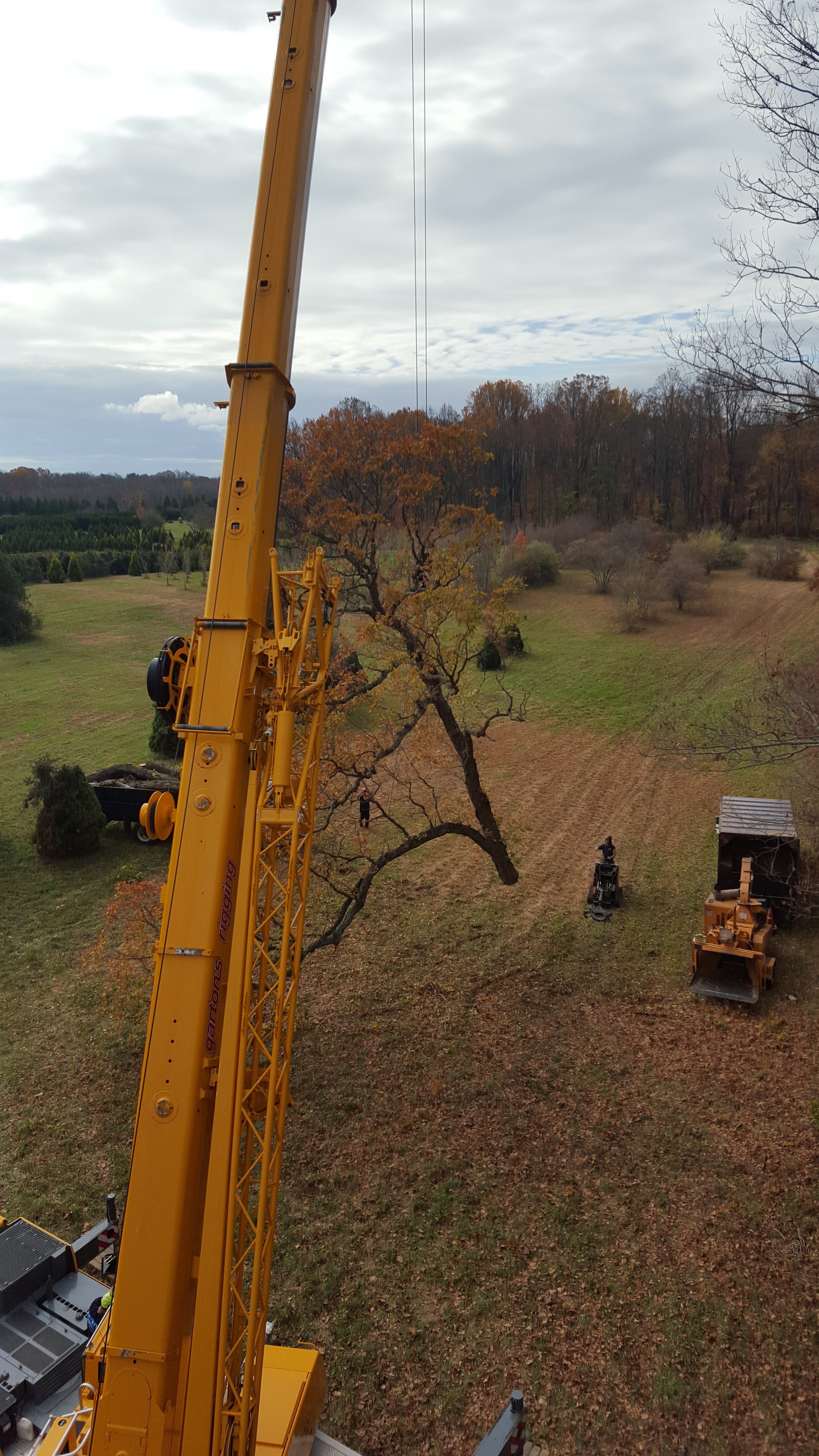
Here are some general guidelines: number one, never skip a job briefing. A lot of people get really anxious wanting to get started. You have a 132-foot tulip tree and the crane is setting counter weights up and things are not happening and it is nine o’clock and there is no sawdust flying. This doesn’t mean you skip the job briefing; that would be a big mistake. You still do what you have to do to work safe.
Include a rescue plan in that job briefing. What is going to happen if I, the climber, get hurt or if someone else gets hurt? Who will do what and how will you proceed? Know the rescue plan before you need it.
Everyone should know that you have to build in a safety factor. What does that mean? It means that you and the crane operator and crew determine a percentage of the cranes capacity that you will not exceed. For example, if the capacity at a given radius is five tons, you develop your rigging plan to work within the limits of say sixty percent. This will give you a cushion should you make an error in calculating the weight or any potential movement that was unplanned.
Some other rules are to inspect your slings with each use. Avoid shock loading at all costs. You never want to dynamically load a crane or bounce anything into it, rather keep things as static as possible.
If you are new to crane work, the first thing that I will tell you is it is not like conventional rigging. Once you are ready to make the cut, you have to cut through and finish the cut one way or another. You can’t leave a hinge or any fiber in place as this will inhibit the crane’s ability to lift without over-tensioning and ultimately cause a jolt. Trying to pull apart even a pinky-sized piece of fiber could require as much as 2500 lbs. of additional force to separate it. This is not a good practice. Finish your cuts. You have to cut it through.
Limits of radius
Work within the limits of the furthest radius. The distance between the crane and the object being lifted or moved is the radius. If the radius to the tree is eighty feet, yet the radius to the landing zone is one hundred, the drop zone is further away and should be considered for the capacity of the lift.
Communication
Lastly, communication is everything. When we get on a job site, the first thing that we do is discuss what we are going to do, how we are going to do it and make sure everyone is on board. If the operator says “no,” I say “OK” or I try to convince him. That works both ways. We have to agree and everybody on the crew has to be part of that.
We also use headsets during the work. Nobody has ever told me that they don’t like using headsets after they try them. They can improve communication so that everyone on the job site knows what is going on. They also enable communication for blind pics, dark conditions or other less-than-ideal conditions where hand signals may not suffice. I wouldn’t work without them in most situations now.
Climber/bucket operator concerns
Here is what you need to do as a climber or bucket operator. Number one, use proper work positioning. You don’t want to be hurt because you are not climbing properly or place the bucket truck in the wrong position. Two, use a green log weight chart and know what you are dealing with. Three, communicate to the operator what you want to do before you do it you get his approval.
Plan your rigging around what you see in the shape and how the piece can be balanced. Talk to the operator about where you are going to make your cut so you can capture the center of gravity. Plan it right before you rig it. Start your cut around the more difficult side first and work to the side that you are most comfortable on. That is your finishing spot and is where you want to be when there is movement.
Be prepared for the worst situation. I hate hearing climbers say that they got hurt. I know sometimes you can’t help it, but I hate it more when a climber says that he got hurt and when I ask how they tell me that something went wrong and they expected it caught them of guard. Plan for things to not go perfectly and if something does go wrong, you’ll be much better prepared and hopefully avoid an injury.
Make your cuts with confidence. Everyone is a little anxious when you are not used to doing something. You can use that energy to be prepared and focused, but you can’t be anything but confident when you make that cut. Once you make the cut, watch what can be a danger to crew. First and foremost it is you, but then it is the crew. You are not done once the piece is away, you have to keep watching the operation and helping to spot potential issues before they become a threat.
Lastly, re-evaluate your plan. Don’t be stubborn. Make a change when you need to no matter what it means to your ego.
Tying into the tree
When you get into big pieces, you have to have a plan to tie in to the tree and to do so safely. There are many scenarios we could discuss about work positioning, too many for this article, but let me at least mention cutting on the bad side.
With bucket work you get into a lot of bad-side situations. If you can’t cut straight through a piece – you are on one side and can’t reach through at the end of the cut – the first thing you do is move into that bad spot, such as underneath the piece, or with the bucket under the piece. You cut that section first when there is no chance of movement. If you wait until the piece is almost through to cut that piece, it could sit down on top of you when it releases. You don’t want to be under it if it drops or where it could move and pin you between it and the tree when it comes off. So, cut the bad side first, then finish from the good side, where the bucket or you are out of harm’s way and in your most comfortable position.
Making the cut
What types of cuts do you want to use? The easiest for me is a straight cut. If I can get up there and just slice right through something that is what I do. And I do it quite a bit on brush work, especially the smaller stuff.
You can use a snap or overlap cut, which lets you get out of the way and the crane can lift the piece and break it off pretty easily. What is the potential for a problem? You leave too much fiber in the wrong situation and you have to overload the crane to get it to break off. There is a little room for error, and it takes knowledge of what fiber is stronger than others and how thick and how far apart the cuts should be to work properly. These ansers will vary and that gets more complex in nature.
The face and back cut is can be useful in crane work and I know some people love it. I prefer not to use it much if at all because it too is very complex from the standpoint of keeping the boom in the right position all the way through the life and having the piece only release at the perfect time,
One thing that I am fond of is irregular cuts. One example is what I call a “V” cut where you make two intersecting cuts in the shape of a V. It doesn’t have to be a V, but it’s usually two angular cuts that lock a piece into position to keep it from falling or pushing in different directions. I also use something I call a wall-and-shelf cut. The difference between a V cut and a wall-and-shelf cut is that the latter is flat in on one side and the V is angular in both. Both allow you to control branch movement as it comes off the cut and allows the operator the luxury of lifting slowly out of the cut with little risk of sudden drops.
Something a friend of mine showed me years ago I also like is a sawdust cut, which is a good cut to use especially for the trunk cut at the ground. All it is really is a circular cut where you bore into the center of the tree and you run around cutting with the top side of your saw and you finish the cut all the way around where you started and it is totally cut through. This jams the sawdust in the cut as you work instead of throwing it out and that sawdust is enough to keep the piece from sitting down when finished and pinching your saw. Basically your goal is to bore into the center and just pivot around so you know everything is cut. It’s a great cut to know.
What I encourage people to do is use everything available to achieve your goals. What I find most common is everyone cuts everything like it is a pruning cut. It doesn’t matter here if it looks nice – it’s a removal. Change a cut and don’t think about what it is going to look like. Some of my cuts, when they hit the ground, are the goofiest looking pieces you have ever seen. If it serves a purpose then it’s notnthat goofy after all.
In a lot of these cuts, try to cut more than you think you need to. It may take two more seconds, but you are not going to leave that little piece of fiber that causes an issue. I overcut a lot because I want to be sure it’s off. Same with the V cut or shelf cut; it isn’t a perfect V, rather a little bit like an X. The two cuts overlap slightly so you know that you have the cut done totally.
What the ground crew needs to know
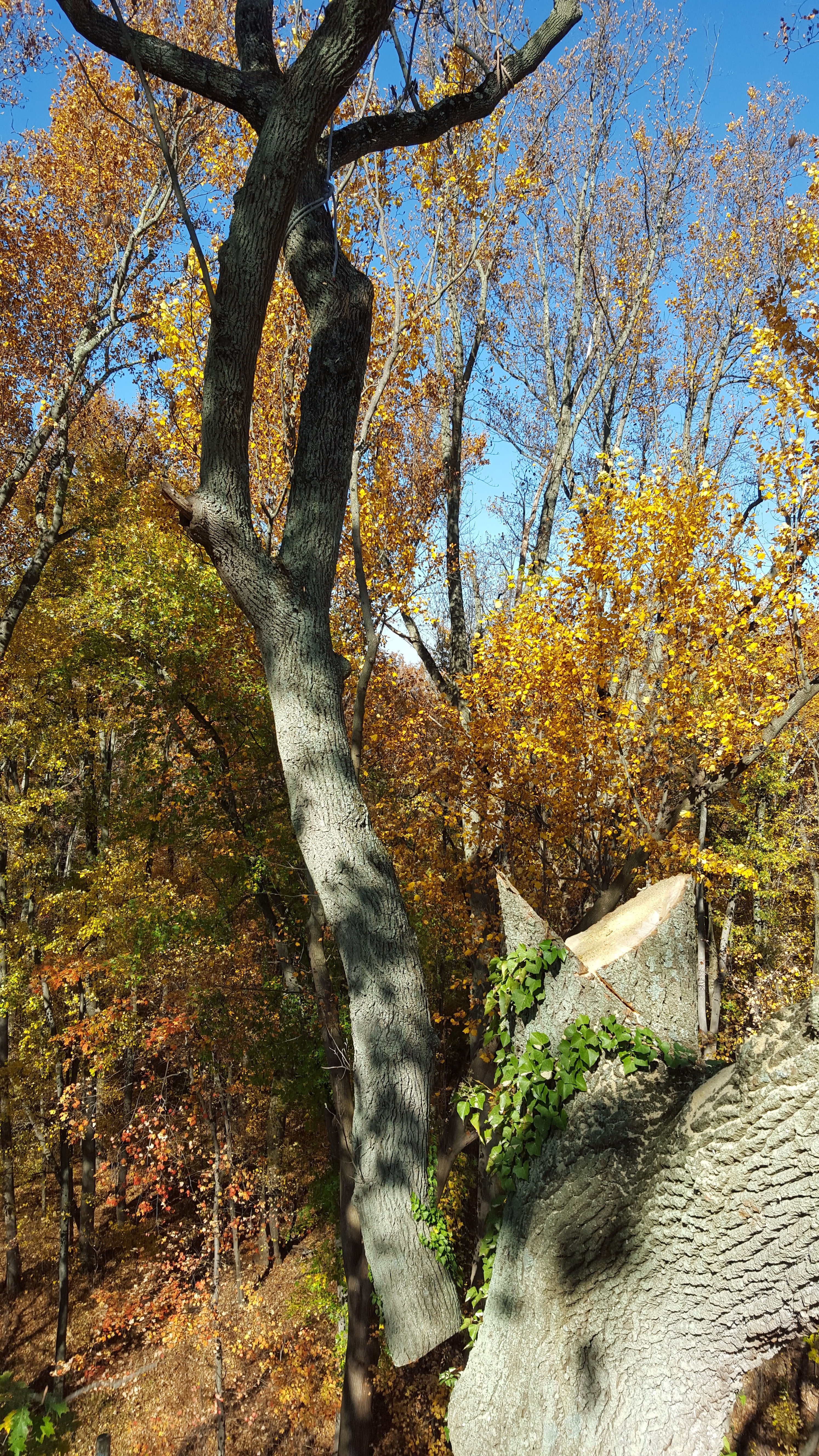
I couldn’t do what I do without the right things happening on the ground. It would be a nightmare. But if the right individuals are there, it is a good experience.
You have to know how to set up your landing zone; that is first and foremost. Number two is get the crane back as quickly as possible. The longer the climber is waiting for that hook, the less is getting done. Don’t worry about if it faces this way or that way, put it on the ground as quick as you can, safely, and the get it untied and get the crane back. The ground crew should have time to do everything they need to do before the next piece comes down.
Watch for shifting when you are landing that piece and while cutting it. When you have pressure on a big limb, you have to cut that piece like a spring pole because they can react violently. Make sure you use the right cut. And, if necessary, before setting the piece all the way down, keep some weight on the crane to help alleviate that stress while making that tensioned cut. That alone could prevent a hazardous situation from arising.
Another thing to think about is to pay attention to change in the sling tension. When you start to lower something, things can flip and then one sling may be doing all the work and maybe that piece isn’t strong enough to support the whole load and could break if the weight shifts. Or, when you put a piece down, sometimes it shifts and a branch might catch in the load line and flex to the point where it breaks and shoots back when you are getting ready to untie the sling. You have to stay alert and watch how things change.
Don’t pull the hook off center to unhook the slings. Why? Because when you let it go it may hurt the crew member untying the other side. You may clobber him or her with a 500 pound hook and they wouldn’t even see it coming.
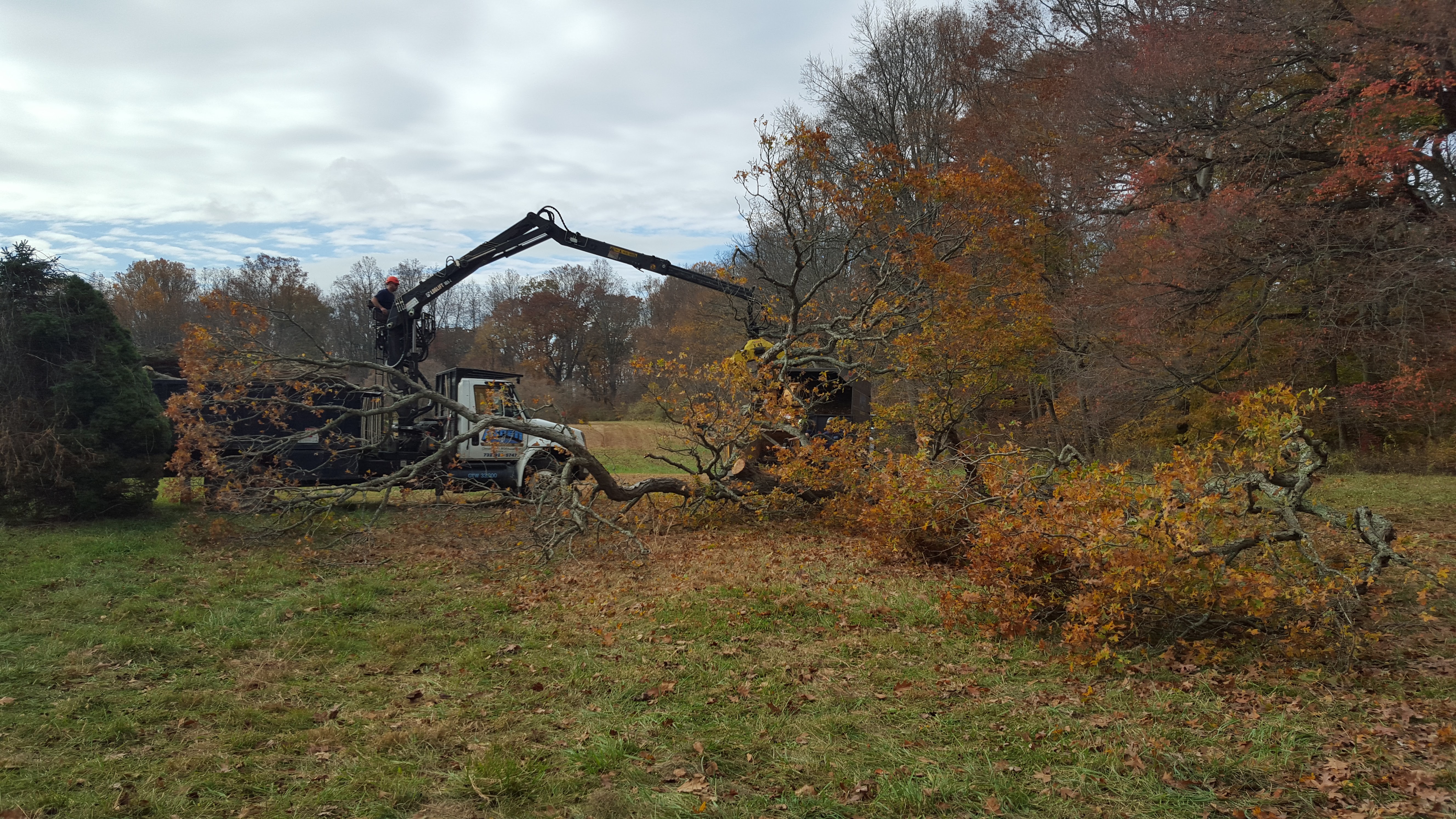
Keep the site clean of debris. The hard part about that is planning ahead. When you see this stuff coming down you have to know where it is going. When the wood comes off put it in a place that’s out of the way for the brush. You have to plan ahead.
You may be using a loader or grapple truck to manipulate pieces on the ground and to feed a chipper. Some of the best equipment we have ever bought is a log truck and a mini loader. They help make short work of the large debris. And the minis are not that expensive compared to what you can do with them. I wouldn’t work without one now. We now have one for every crew.
Summary
Crane work and all tree work is all about safety and efficiency. When I look at how I am going to complete a job, my number one concern is safety. What is my number two thing? Profitability. I will do something that is less efficient for me and maybe work harder if I know it is going to get it get done quicker. For example, do I use a bucket truck in a tight yard and make a mess that can’t be cleaned up simultaneously or do I just climb it and clean it up as we go; which is harder on me, but is better for getting the job done? Of course I choose the latter. I always say work smarter AND harder.
Remember to work to estimate the weight accurately. This is where most of the accidents that I see happen. You have to have a plan for being wrong and work at being right.
Use everything you can to increase your safety and enhance your performance as a team. Every cut is not the same straight up and down pruning cut. Use every bit of creativity that you have to reach your desired results. Never leave anything to chance; calculate everything and always be open minded to the suggestions of everyone on the crew. The more minds involved the better!
Mark Chisholm is with Aspen Tree Expert Co., Inc., a 28-year TCIA-member company located in Jackson, New Jersey. This article was based on his presentation at TCI EXPO 2014 in Hartford, Connecticut, on the same subject. To listen to an audio recording of that presentation, go to this page in the digital version of this issue of TCI, at www.tcia.org under Publications, and click here.
TCIA Fatality and Near Miss Report
|
TCIA Member Alert: OSHA Regulations and ANSI Standard Reviews
| OSHA Bans Body Belts & Lanyards in Buckets |
| In its announcement of a Walking-Working Surfaces and Personal Protective Equipment (Subpart D) final rule on November 18, OSHA put tree care employers on notice that conventional body belts and lanyards used for fall protection in aerial lifts would no longer be acceptable as of the effective date of the rule, January 17, 2017… Full Story |
| ANSI Z133 Standard Third Public Review |
| The third review period of the ANSI Z133 is upcoming and the deadline to submit your comments is 12/18/2016. Read the original article to learn what topics you can comment on and how to go about submitting your comments… Full Story |
Six Pro Tips To Marketing Your Tree Care Website
- Clean Consistent Citations
We all know what citations are. The Yelps, the Home Advisors, the BBB’s. Over the the last year even, these have doubled in importance for Google ranking factors. In 2010 Google came out and said “Blogs are good, everyone should have a blog!”. And that’s indeed what we did. But on second thought, why would a plumber, locksmith or an arborist even need to worry about blogging?
No, your “5 tips to prepare your garden for winter” probably won’t go viral, unless you really put some time into it and made an amazing piece of content, even then if you don’t have a heavy amount of traffic to your site, unless you promote it, it’s rare that it will go viral.
So, that’s why reputation management is the new black. Make sure you have accounts on the top 50 directories which you can find here. We will talk about reviews soon.
Also make sure your business name, phone number and address is 100 percent consistent across the board. You can check this information at sites like Bright Local or Synup.
- Schema
This is a little advanced but it’s becoming a must have. Schema is a way for Google to read your site faster and more efficiently. It’s basically like just telling Google “Hey, I am a small business, I have a location, Theses are my hours, this is what I do.”
Do it yourself here and throw it in the footer on you website: https://supple.com.au/tools/local-business-schema-generator/
Or just take this code, replace with your info and throw this in the footer of your site in an HTML box.
<div itemscope itemtype=”http://schema.org/Organization”>
<span itemprop=”name”>Your tree care website</span><br>
<div itemprop=”address” itemscope itemtype=”http://schema.org/PostalAddress”>
<span itemprop=”streetAddress”>Put address here</span><br>
<span itemprop=”addressLocality”>Portland</span><br>
<span itemprop=”addressRegion”>Oregon</span>
<span itemprop=”postalCode”>97267</span>
</div>
Phone: <span itemprop=”telephone”>555-555-5555</span>
</div>
And remember that code above is super general. Schema can get way more in depth. So at least have this, but I would hire someone to make it more comprehensive.
Or hire someone to do it on fiverr. I wouldn’t pay under 30 bucks for it. Get someone quality. To learn more about schema you can watch this youtube video: https://youtu.be/MV7a60xCV5c
- Google My Business
You mean Google Local? No… Oh Google plus?! No, G+ is about to be officially dead…` GMB (Google My Business) is now the one stop shop for all things Google maps related. Your GMB profile is the nucleus of your map rankings. We all know that map rankings come up first on a Google search, so having it in the top three is basically our main goal.
It’s absolutely crucial that you fill out your GMB profile 100 percent.
- Get as many photos as you can on there. Good quality photos!
- Make SURE you have the right category. I see this a lot. People will put themselves under categories that they shouldn’t be under. Make sure it’s ONE category, TWO max if you really need it.
- 360 virtual tour – this is something you can do if you have a storefront. I would suggest researching more about it and doing it to have an edge on your competitors. Read more here https://www.google.com/streetview/earn/
- You should just read this too – very well done report and easy to understand. http://www.localseoguide.com/guides/2016-local-seo-ranking-factors/
- Reviews
Ok let’s finally talk about it. As I mentioned earlier, reputation management is very important in 2016-2017. So my question to you is, “Do you have a review strategy set in place?”. I’ll just show you what I like to do .
- Find out all the places you want to ge review on like BBB, Home advisor, Angie’s list, Yelp, Facebook, and of course the all powerful GMB.
- Make a page on your website called “review us on this platform” or something like that. Put all those links on the page with an icon so customers can easily tell which platform he/she will be leaving a review on.
- Make a nice pitch email, asking the [happy] customer to review you on one of these platforms.
- Boom – get those reviews baby.
- And read this! This will seriously help with your review strategy. http://www.localvisibilitysystem.com/2015/09/16/60-plus-questions-to-troubleshoot-and-fix-your-local-reviews-strategy/
- Do some videos
Did you know, it’s 52 times easier to rank on Youtube than on Google search? Have you ever done any ‘how to’ videos or training videos? Or, i’m sure you use many different tools when you are taming those trees. Are there any tools or products you just couldn’t live without? Then you should do a tutorial or a product review and grab that traffic!
No it’s usually not going to mean a job conversion, but it’s going to raise the authority of your site. That way you can rank faster for terms like “Tree care Portland Oregon” or Tree removal Redding Ca”.
Remember, the more your name is out there, the higher your authority will be. One of the biggest mistakes I see business owners do is not want to make any content that teaches people how to do it themselves or even give out simple tips because they think people will just do it themselves and not convert into a paying job. But the truth is that person wasn’t ever going to convert. The people that do it themselves will always do it themselves and the people that buy will always buy. Make valuable content, help people in anyway you can, and give away free stuff. Then you will be on the right track.
Read this to master Youtube: http://backlinko.com/how-to-rank-youtube-videos
- Get involved in the community and sponsor your local non profits!
Guys let me tell you, this is such a great way to start a buzz. If you are a business that takes it’s precious time and gives some of it back to the community, it will come back to you. Don’t be afraid to get out there!
For example. We have an organization called “Friends Of Trees” out here in the NW. They have programs where they take a bunch of middle schoolers out to go plant trees. Consider sponsoring things like that. The community WILL notice.
Also, consider giveaways and promotions. Do a photo contest of something like (and this is just of the top of my head) “Rarest trees in your backyard”. Promote it on Facebook, and whoever has the rarest tree gets a $200 gift card to Home Depot or something. Get creative, this actually is one of the fastest ways to make a buzz and build authority.
Last thing to remember. Google is getting better and better at weeding out bad businesses and giving the searcher truly the best options. The companies with the best ethics, reviews and work will eventually get to the top.
Get out there and make some magic happen!
About The Author:
Tom Danowski is a marketer for Inexpensive Tree Care, a tree removal service based out of the NW.
Professional Interoperability- Working With First Responders
|
|
|
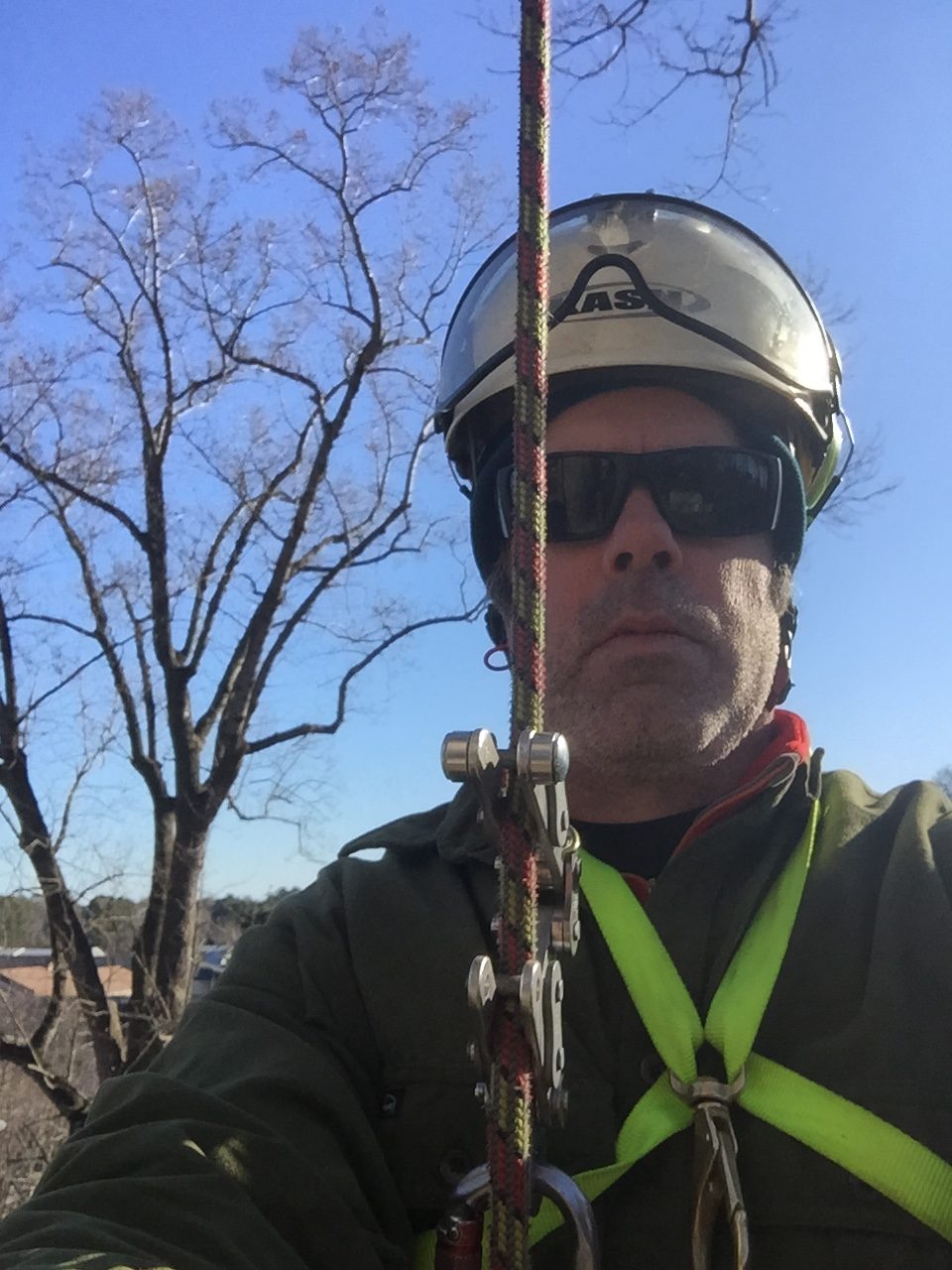 Steve Connally is a ISA Certified Arborist with 15 years climbing experience. He is currently a production climber with a Commercial Tree Service based in Virginia Beach. Steve is also a Captain with Norfolk Fire Rescue in Norfolk Virginia and has extensive training and experience as a member and a Supervisor of Norfolk’s Technical Rescue Team. He has 20 years of experience in the fire service and as a Paramedic. Steve is a member of the MAC ISA Safety Committee and can be reached via email at steve.connally@gmail.com
About the book Fall Factor

With the novel Fall Factor, I really wanted to tell three stories. First, the trials and tribulations of family run businesses, especially tree businesses. I grew up in arboriculture. My father never owned a tree business, but working for one consumed his time through the 70’s and 80’s.
His devotion to the care and study of trees trickled down through the family. Both my older brothers gravitated to arboriculture and/or outdoor work and study, as did I. All three of us would eventually work in the field. My oldest brother owns a successful tree company in Lancaster, Pennsylvania. I worked directly with him for over two decades. I still work with the company.
I never intended to be a climber, an arborist. Leaving high school, I drifted away from what I would come to realize later was a lifestyle. I drifted back in almost by accident. When my brother needed help, I needed a job. This story is so common in tree care business, I wanted to tell it. I have no regrets for my choices. The path I chose worked out, well with success on all sides. However, I think now I would not recommend it to a younger me.
Were it not for the family connection, I think I would have left the profession long ago. Like so many family members working in a family business, I quit every other Friday, only to return Monday morning. There were many rough patches, as only family business can create. There were also many more successes. My family connection kept me there, forced me to succeed despite myself. For this, I am eternally grateful to my family.
This story, this interaction, permeates Fall Factor in its own way. Dramatized by addiction, emphasized by time and distance, I told the story the best I knew how, while trying to blend in the struggles common to tree folk, the struggle to work, make money, support employees and their families, work safely and remain sane. These are struggles my brother knew from the get go. I have come to realize that if the business folded, I just needed a new job. He and my sister-in-law and niece, would need a whole new financial life. It took me a long time to realize the burden small business owners carry, the financial risk, the human obligation inherent in employing people.
Second, I wanted to tell the story of many returning combat veterans. The story of isolation through experience and experiences. The feeling of loss when one comes from a tight knit group with shared experience, to not having that type of support and friendship. The feelings of loss for Chris are as much for his brother as they are for his brothers in arms. Loss is a recurrent theme in the book. Chris lost connection and left home, only to lose connection again and have to return home, to the loss of a brother he left to a fate he chose to not cope with.
The third story is that of people swept up by circumstance, some within their control and by choice, and others controlled by the whims of fate or others people. We all move through this world based on a set of choices. The consequences of these choices construct a path. We can chart a course, alter the path to an extent, affect action. Who and what we become is the result of all this. The myriad of choices, the personalities that are involved, fascinate me as a writer, as a human moving down his own path. The interaction of choices made, unmade and made for us by others and/or the whims of fate also weave through the story.
My sincere wish is for all readers to enjoy the story. To have it change them is some small way. To affect the way they see this wonderful world we live in.
Anthony Tresselt